

In industrial environments, it is very common to encounter a large number of obstacles, level differences, and areas where continuous passage becomes impossible.
In these situations, preventing accidents becomes a priority. For this we have structures that offer an effective solution to such situations: crossovers.
In this post we are going to talk about why these structures are so important in industry and what purpose they serve. Let’s get started.
What Obstacles Do We Find in Industrial Environments?
In any type of industry, such as production plants, logistics buildings, treatment plants, or roofs in general, we can find obstacles that prevent us from walking through them continuously, since it is common to encounter elements such as:
- Machinery.
- Conveyor belts.
- Structures.
- Pipes.
- Electrical grating.
- Level differences in the design itself.
In situations like these, unsafe areas are created for operators and users to pass through. Generally, if such situations have not been planned for, workers end up improperly crossing over these elements, creating accident risks.
Crossovers arise from this need to bridge those obstacles and create safe work environments.
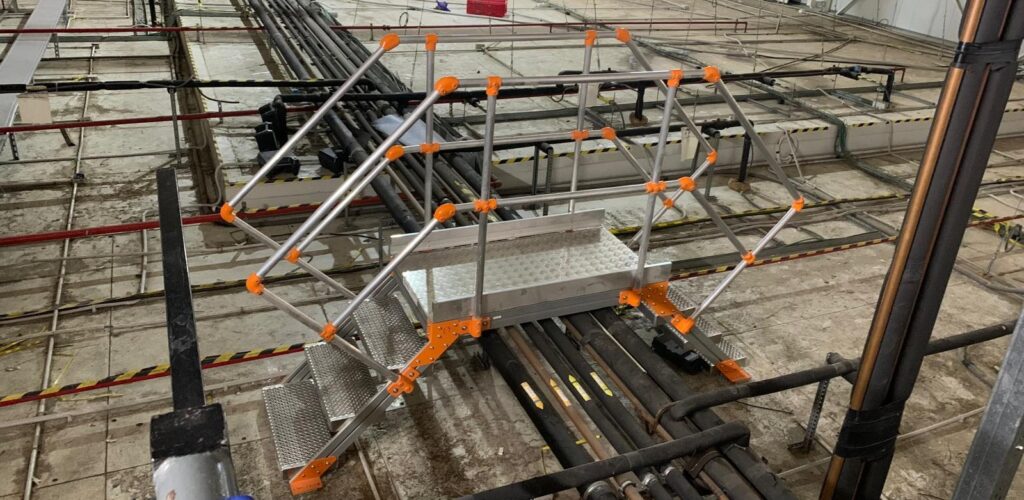
Crossovers are metal structures that, thanks to their design and manufacture, make it possible to create an elevated walkway. Their components are:
- Ascending stairs.
- Horizontal platform.
- Descending stairs.
- Safety guardrail in cases where the crossover reaches a height greater than 500 mm.
Why Are Crossovers Useful in Industrial Environments?
These safety systems create continuity and allow users to get from one side of the obstacle to the other without having to step over the elements that put them in danger, thus avoiding reckless behavior and the risks arising from it.
But that is not the only reason these elements are so important. Let’s see what else they can offer us:
- Safety for users: It is worth noting that this is the main purpose of crossovers. With these systems we protect operators and prevent them from walking through areas where passage could pose a risk.
- Ease of movement: A well-designed work environment makes the job easier without unnecessary detours, thus reducing the time staff need to perform their duties.
- Ability to adapt the environment: Installing crossovers makes passage easier without having to redesign the workplace or make modifications that involve high costs.
- Regulatory compliance: Another important aspect is compliance with occupational health and safety regulations. Installing these safety systems prevents potential accidents and thereby ensures compliance with those regulations.
- Manufacturing flexibility: Since they are generally modular structures, they can be adapted to any environment and even reused, adapting them if a new need arises.
- Prevention of hidden risks: Not all obstacles or risks are visible. There are others that we can avoid thanks to these systems, such as residual heat near certain areas or pipes, electrical hazards, or vibrations that machines can transmit, making it hard for the worker to stay stable.
Conclusion
At first, a crossover may seem like a simple structure, but in reality it is a very effective way to bridge both the obvious and the hidden obstacles that we can find in any industrial environment.
With them, we will not only bridge level differences, but also create safer, more efficient work environments and ensure compliance with current regulations.
To select a device correctly, one that truly fulfills its function and gives us the safety we need, at Ypsos Safety we recommend turning to professionals in the fall protection sector to efficiently carry out the proper risk assessment, installation, and certification of the system.