


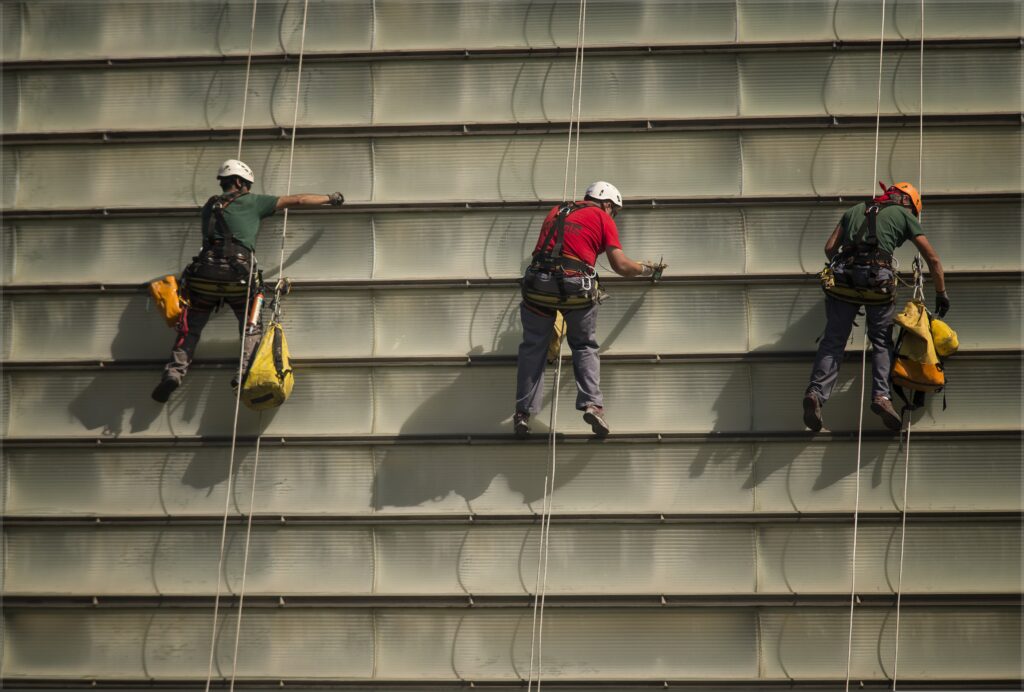
Although they are often used as synonyms, they do not mean the same thing; one describes a risk and the other a technique for working. The difference between work at height and rope access work affects how the task is planned, what equipment is needed, what training personnel must have and how rescue is organized. Before choosing among the different systems for work at height, it is worth being clear about what counts as work at height and when we are talking about rope access work.
What Is Work at Height
Work at height is any activity performed at a height sufficient for there to be a risk of fall with possible injury. The specific height is defined by each country. Some regulations set it at 1.5 meters and others at 1.8 meters or more. In Spain, for example, the workplace regulation (RD 486/1997) requires protecting drops of more than 2 meters where there is a risk of falling. You should always review the legislation applicable to each sector and each job site.
Some examples of work at height:
- Scaffold assembly and dismantling.
- Maintenance from baskets, lift platforms or ladders.
- Work on rooftops and roofs.
What matters is that the concept is defined by the risk of falling, not by how the work is carried out. To control it, guardrails, nets, harnesses, anchor points and lifelines for work at height are combined, along with specific training, work-at-height permits and periodic inspection of the equipment.
What Is Rope Access Work:
Rope access work is an access and positioning technique using ropes. It is used mainly so that the worker can move safely and work suspended on facades, towers or chimneys. It is also the usual technique in rope access work on wind turbines, where workers access with ropes to inspect and repair blades and other hard-to-reach areas. This technique is used when setting up scaffolding or a platform is unfeasible, since it is usually too slow and costly.
This technique is based on a system of two independent ropes, each with its own anchor. One of the ropes is the main or working rope, which supports the worker and lets them move; the other is a safety rope, which acts as a backup and protection. It is complemented by a harness, descenders, ascenders and a helmet. It requires specific training and certification, and must be done as a team, always with a minimum of two people, with supervision and a predefined rescue plan.
- Concept: work at height is a risk category, while rope access work is a specific method or way of carrying out a task.
- Scope: work at height includes scaffolds, ladders, platforms, guardrails, nets, lifelines, etc., while rope access work is limited to the use of ropes (such as vertical lifelines).
- Protection: at height, collective protection is the priority (guardrails, nets, nets to cover skylights). In rope access work, safety depends on the rope system and on personal PPE.
- Training: for work at height, a safe work at height course is generally enough. Rope access requires more specific technical training in rope access.
- Rescue: in rope access work, the rescue plan is especially critical, because the worker is suspended throughout the job.
In short, all rope access work is work at height, but not all work at height is rope access. A worker repairing a roof using perimeter guardrails is doing work at height. Someone cleaning a facade while suspended on ropes is doing rope access work, which is also work at height.
Frequently Asked Questions About Rope Access Work
Work at height is any task with a risk of falling from height, regardless of how it is accessed. Rope access work is a specific rope-based technique within that category, used when other means of access are unfeasible or impractical.