


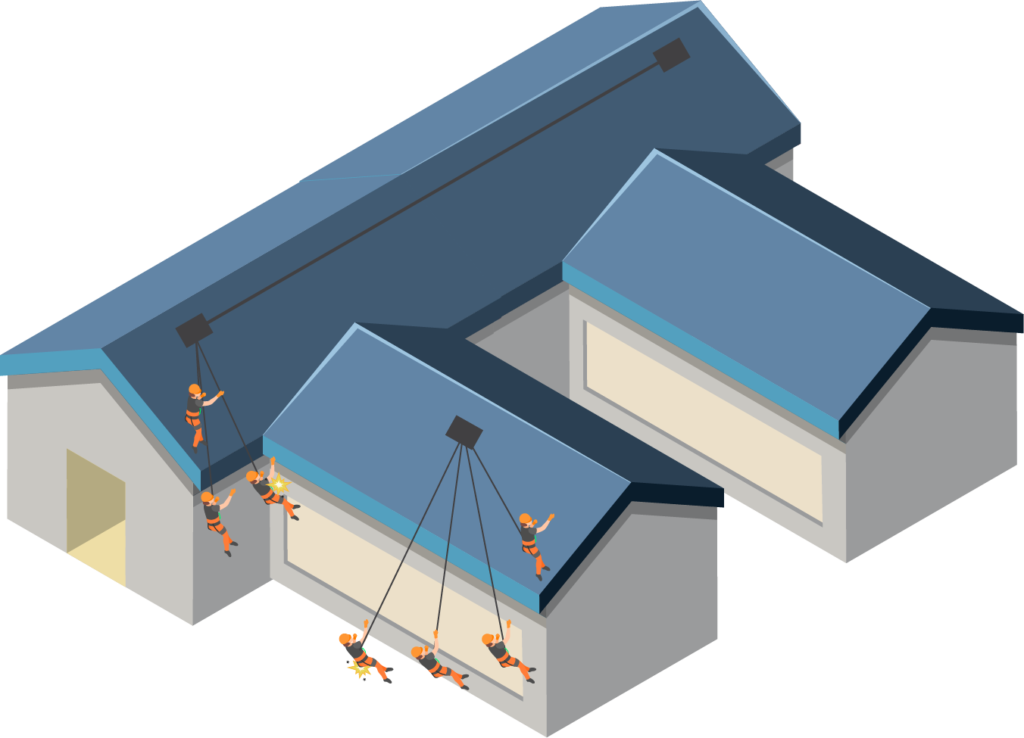
To analyze what the pendulum effect is, we need to picture the situation in order to understand why it occurs.
When we install horizontal lifelines on roofs, we think that is enough to guarantee the safety of the workers who go up there to do any kind of work.
Sometimes that is not the case: when a worker has to approach a corner of the roof to do something, they don’t know that the pendulum effect can occur in the event of a fall, and the lifeline is not going to prevent them from reaching the ground.
What Is the Pendulum Effect?
The pendulum effect refers to the risk of swinging that occurs when a person falls from a position lateral to the lifeline and the restraint system causes a pendulum-like movement toward the anchor point.
This phenomenon can cause the worker to swing sideways and strike structures, edges, or other elements in their swing path.
How Does the Pendulum Effect Occur?
The pendulum effect occurs mainly when the worker is anchored to a lifeline or anchor point, but moves a significant lateral distance away from this point and close to the edge of the roof.
If a fall occurs, because the worker is at a diagonal to the lifeline, a swinging movement will be generated instead of a direct vertical fall, until the worker is perpendicular to the anchor point.
If the diagonal is very wide, the worker may reach the ground in the event of a fall, which can have very serious, even fatal, consequences.

Some examples of what could happen are:
- Impact against structures: While swinging, the worker could strike lateral obstacles, which can cause serious injuries.
- Rope cutting: If the worker swings and the anchor system or rope comes into contact with sharp edges, there is a risk that the rope will be damaged or cut.
- Increased impact force: The swinging can generate greater impact force when the worker hits an object or structure, increasing the risk of injury.
How Can the Pendulum Effect Be Prevented?
To minimize the risk of the pendulum effect on roofs with lifelines, some key precautions can be taken:
One of the most effective and economical measures is installing anti-pendulum points. These points should be placed at the corners where the worker has to approach to perform any task. In that case, when moving there, the worker would anchor to that anti-pendulum point and, in the event of a fall, would not swing or reach the ground.
Another option is to install several horizontal lifelines, one central line along the roof and others along the sides to cover the risk of working at the corners. In this case, if a fall occurs, the worker would be perpendicular to the line, which eliminates the risk of the pendulum effect.

These two options are the direct remedy for preventing swinging in the event of a worker falling on a roof. The choice would be made based on each customer’s needs and the requirements of each roof.
Avoiding the pendulum effect is crucial in work at height, since it can seriously endanger the worker’s safety and reduce the effectiveness of fall protection systems.
Controlling the pendulum effect, through proper anchoring practices and appropriate protective equipment, as well as training and informing workers about these risks, is fundamental in any safety-at-height strategy.