


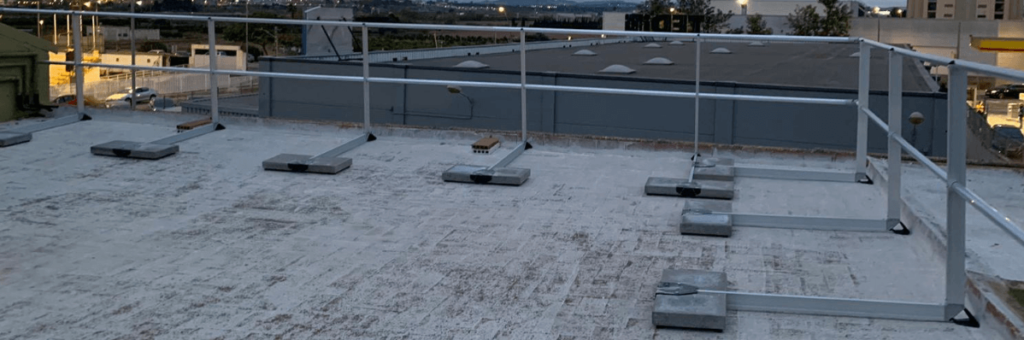
In the following post, we will dig deeper and look at the cases in which it is advisable to install safety guardrails.
So far, we have talked about safety guardrails, covering their varieties, where to install each model depending on the type of roof, components, etc.
Occupational Health and Safety Law
Starting from Law 31/1995 of November 8 on Occupational Health and Safety (hereinafter, OHS), Article 15, paragraph h, specifies that measures giving priority to collective protection over personal protection must be adopted.
Here, we already find one of the main reasons for installing this type of safety system: its collective protection function.
But as we will continue to see, it is not the only reason to do so.
Installing Safety Guardrails as Perimeter Protection on a Roof
Imagine an industrial roof with equipment that requires maintenance and inspections. The workers who perform the maintenance tasks must have specific safety training for work at height so that, individually, they can move across roofs without risk of accidents.
In these cases, roofs must be equipped with tie-off elements and perimeter safety devices; we may find lifelines or anchor points, which on certain occasions, because of their layout or because of the routes needed to reach the maintenance points, are insufficient.
A good solution would be to equip the roof with perimeter protection guardrails, ensuring that all users can move across the entire roof with the necessary safety.
In addition, we must take into account the other risk areas on these roofs, such as skylights and domed skylights. These translucent elements should be protected with the various safety products available on the market to complement the safety of the people on the roof.
In these cases, the individual training mentioned above would no longer be necessary, which is another reason to consider when choosing safety guardrails, adding collective protection over personal protection, as the Spanish Occupational Risk Prevention Act (LPRL) indicates.
Installing Safety Guardrails Around Roof Openings
As we have already mentioned, these are not the only cases in which choosing these safety systems is a good decision.
There are other circumstances in which we can choose perimeter protection guardrails, such as:
- As protection for flat and domed skylights.
- As protection for domed skylights.
- As protection for smoke vents.
In addition to these situations, we can also install safety guardrails where the roof wall or parapet is insufficient, less than 1100mm high, and there is a risk of falling from height.
It is worth remembering that, although these systems are most often used in industrial settings, safety guardrails can also be installed on residential buildings.

Installing Safety Guardrails in Industrial Areas
Safety guardrails are not only used as a perimeter protection system; we can find them at machine access points and as a complement to stairs, walkways, and crossovers.
The regulations state that when the height of the systems mentioned above exceeds 500mm, they must have guardrails, built to the construction specifications set out in standard UNE EN ISO 14122-3:2016 Stairs, stepladders and guardrails.
In these cases, whether on stairs, walkways, or crossovers, safety guardrails become a mandatory complement to the selected systems, protecting against fall risks, in this case from the sides and front.
These guardrails include the adaptations needed to be attached to the safety and access systems mentioned, but in terms of manufacturing and construction, they follow the same guidelines and technical specifications as the guardrails used for perimeter protection.
Safety Guardrails as a Complement
As we can see, these safety systems are highly versatile, making them not only a very complete system but also one of the safest against the possibility of falls from height.
It is worth remembering that safety guardrails complement the other protection systems against accident risks. We can easily combine perimeter protection of a roof using these systems with lifelines, anchor points, and skylight and domed skylight protection using safety nets.
In conclusion, all of these systems are compatible and complementary. The better protected our roofs, machine access points, and other systems that enable passage or improve movement are, the fewer accident risks we will take on.