


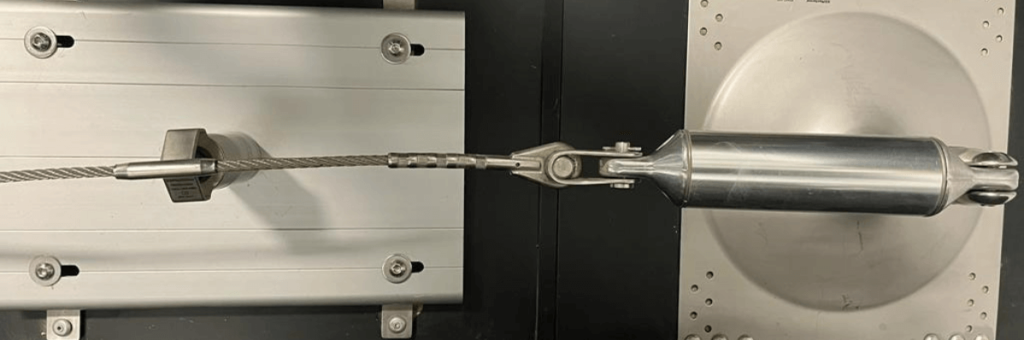
In this article, we will identify the components or parts that make up a lifeline.
We have previously discussed what a lifeline is, what types exist, and how to inspect them. This time, we will take a closer look at the components that make them up.
Main Components of a Lifeline
A lifeline is a fall restraint system used when working at height.
Lifelines ensure workers’ safety and, in the event of an accident, arrest their fall before they reach the ground.
They consist of a series of components assembled to form a complete system. We will list and break down the main parts of these anchoring devices, which may vary depending on the design and specific application.

Cable or Rail of a Lifeline
The main component of a lifeline is the cable that connects the anchors and allows controlled movement.
This component can be of several types:
- Textile, when the lifeline is temporary.
- Steel cable, for flexible lifelines, which can be installed both horizontally and vertically.
- Rail, for rigid lifelines. These can also be installed vertically and horizontally. This type is always paired with a trolley that slides along the rail.
Anchor of the Lifeline
Anchors are crucial components of a lifeline, since they provide secure connection points for the system.
Fixed Anchors: These are permanent connection points installed on solid structures such as steel beams, structural concrete, columns, or walls. These anchors are designed to withstand specific loads and are installed in accordance with safety regulations and the manufacturer’s recommendations.
Among these fixed anchors are lifeline anchor plates. These are devices designed to be fastened to flat surfaces, such as ceilings or floors, using anchor bolts or other fastening methods. These plates provide solid connection points for lifeline systems.
Temporary Anchors: These are portable devices that can be temporarily attached to suitable structures to provide mobile connection points. These temporary anchors can include:
- Roof anchors: Attached to roof beams or trusses.
- Beam anchors: Can be clamped to steel beams.
- Column anchors: Wrapped around a column or similar structure.
- Wall anchors: Fastened to a solid vertical wall.
Energy Absorber
An energy absorber is an essential component in a lifeline, used to reduce the impact force experienced by a worker in the event of a fall. Its main function is to absorb and dissipate the energy generated during a fall, thus preventing serious injury to the worker and damage to the lifeline system.
They are usually built into flexible cable lifelines and temporary steel cable lifelines.
Rail lifelines and temporary textile lifelines do not have a built-in absorber, so for greater safety, this component must be incorporated into the connecting element the worker uses.
Curve
When installing this anchoring device, it is sometimes necessary to change its direction because it cannot follow a straight line. This happens when we encounter obstacles or get close to the edge of the roof.
Curves are used precisely in these situations; they are a part of lifelines installed when a turn is needed. Keep in mind that they can only be used with flexible lifelines.
Trolley
As mentioned earlier, in the case of rigid rail lifelines, a trolley is needed in order to move along them.
This device has a carabiner attached, to which the worker must hook their connecting element, which in turn is linked to the safety harness.
Complementary Components of a Lifeline
Once we have identified the components that make up a lifeline, we need to mention the personal protective equipment required to use it.
First, the worker must wear the fall arrest safety harness required and suited to the type of work to be done, as well as a helmet.

The safety harness must be attached to a connecting device such as a lanyard or rope. We connect these directly to the lifeline cable if it is flexible, and to the trolley connector if it is rigid.
An additional component we can add to the lifeline is a self-retracting lifeline. This system makes work easier when we have to cover longer distances and connects directly to our safety harness.
There are more options and complementary components for lifelines that we will look at in upcoming posts. We will also identify the documents required for installation and, once it is installed, items such as the identification plate.