


Classifying how many types of lifelines exist can be confusing in some cases. A single system can be horizontal, permanent, and rigid all at once. These are not mutually exclusive categories: they are different variables within the same classification, and each variable changes the standard that applies and the calculation behind it.
This guide organizes those criteria and explains which to choose depending on the job. If you already know which system you need and are looking for a specific product, learn more about our lifelines.
How Many Types of Lifelines Exist
Systems are classified by three criteria that combine with one another:
| Criterion | Options | What It Determines |
| Direction | Horizontal / Vertical | The risk variable: travel or climbing |
| Permanence | Fixed / Temporary | Whether the anchor is integrated into the structure |
| Line rigidity | Flexible (cable, webbing, rope) / Rigid (rail) | Deformation under load and stopping distance |
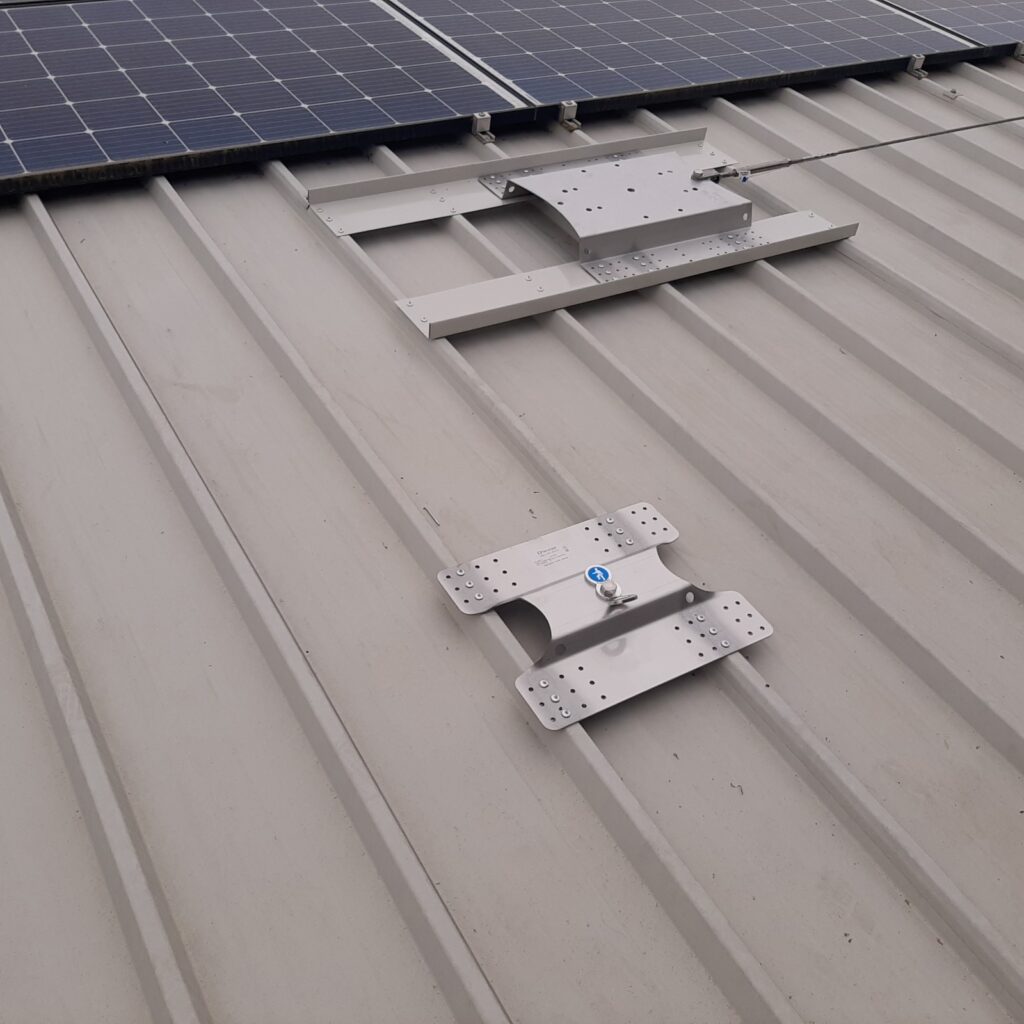
A tensioned steel cable on an industrial roof is horizontal, permanent, and flexible. A rope with a sliding fall arrester on a construction ladder is vertical, temporary, and flexible. A rail on the interior ladder of a wind turbine is vertical, permanent, and rigid. Three systems, three different standards, three different configurations.
By Direction: Horizontal or Vertical
Direction is one of the first factors to consider, and the one that most conditions everything else.
The horizontal lifeline allows lateral movement across the work plane: a roof, a walkway, a structure. The worker moves while connected by a lanyard with an energy absorber and, in configurations with intermediate anchors, a trolley that passes through without disconnecting. It is governed by UNE-EN 795 in its type C (flexible cable) or type D (rigid rail).
The vertical lifeline protects ascent or descent on a fixed ladder, a tower, or a silo. Here the worker climbs with both hands occupied, which is why the system requires a sliding device that follows the user without manual handling and locks by inertia in the event of a fall. This type is governed by UNE-EN 353.
The main difference we see is the moment at which the fall occurs: on a horizontal system, the worker falls from the work plane; on a vertical one, the worker falls during the climb itself. That makes the stopping margin much tighter on a vertical system.
By Permanence: Fixed or Temporary
A permanent lifeline is anchored to the structure for good; its design is defined during the project phase. It requires a logbook, an annual inspection, and a higher initial investment. It pays off when access to the risk area is recurring: scheduled maintenance of HVAC equipment, exhaust systems, and photovoltaic systems, skylight inspections.
A temporary lifeline is installed for a specific job and removed when it is finished. Its anchors are portable and rest on existing structural points, which places it under UNE-EN 795 type B. It is the option for construction sites, structural assembly, and occasional maintenance.
The common mistake is choosing a temporary system to save money when the use is recurring. By the third job, the cost of installing, verifying, and dismantling it each time has already exceeded the cost of a fixed system.
By Material: Flexible Cable or Rigid Rail
Line rigidity is the aspect almost nobody considers, and the one that explains the most accidents.
A flexible line (steel cable, textile webbing, rope) deforms when it carries a weight or a force after a fall. This deformation is called deflection, and it adds distance to the fall. The longer the span between anchors, the greater the deflection.
A rigid line (aluminum rail) barely deforms under load: since it does not give, it generates no additional deflection, and the stopping distance is kept to a minimum.
Why does it matter? Because the critical variable in any fall arrest system is not strength: it is the clearance below the work plane. If a worker falls and the system stops them at 5.8 meters, but there are only 5 meters to the ground, the system will have done its job and the outcome will still be fatal. In low-clearance buildings, mezzanines, and confined stairways, the only viable option is the rail.
The Lifeline as Part of the Harness-Based Fall Arrest System
A lifeline does not work in isolation; it is part of a fall arrest system with three components. This sometimes causes a lot of confusion, because people believe the lifeline protects on its own, like a guardrail, when in fact it requires connecting elements through which the worker attaches.
The complete system has three parts:
- The anchor device: the lifeline itself (UNE-EN 795 or EN 353).
- The connecting element: a lanyard with an energy absorber, a sliding fall arrester, or a self-retracting device, depending on the type of line.
- The fall arrest harness (EN 361), which distributes the arresting force across the worker’s body.
If any of the three is missing, or if the worker does not clip in, the system does not work. That is why the hierarchy of prevention puts collective protection (guardrails, nets, etc.) first, since it protects everyone who gains access without having to connect to anything or do anything to activate it. When this type of protection is not feasible, we then have to install the lifeline.
Which Type of Lifeline to Choose for Your Work at Height
| Situation | Typical System |
| Industrial roof with recurring maintenance | Horizontal, permanent, cable |
| Low-clearance roof or mezzanine | Horizontal, permanent, rail |
| Fixed vertical ladder for access to a roof or machinery | Vertical, permanent, cable or rail |
| Construction site, structural assembly, one-off job | Horizontal or vertical, temporary |
| Heavy-use tower climb | Vertical, permanent, rail |
| Access to a tank, silo, or manhole | Vertical with rescue function |
Another fundamental aspect to consider is the surface where the system is anchored, since each substrate requires a different fastening. For example, on a fiber cement roof the sheet does not accept point loads and you have to reach the purlin, while on a deck roof the anchor passes through the insulation down to the trapezoidal metal sheet without compromising the waterproofing.
The same applies by sector: the solution for wind towers and wind turbines is not the same as for a telecommunications tower, and neither works in confined spaces, where the system must also allow the worker to be hoisted up from the outside.
If you already know what you need but still have to decide on the system, send us the surface type, the route, and the available clearance; we will help you choose the system that best fits your project.
Frequently Asked Questions About Types of Lifelines
There is no fixed number, because the classification uses criteria that combine with one another. The three criteria are: direction (horizontal, for moving across a work plane; vertical, for protecting a climb), permanence (fixed, permanently anchored to the structure; temporary, with portable anchors that are removed when the job is done), and line rigidity (flexible, in cable, webbing, or rope; rigid, in aluminum rail). A single system belongs to one category of each variable: for example, horizontal, permanent, and flexible. What does change with each combination is the standard that applies and the fall distance calculation.
It depends on the classification criterion applied. Sorted by direction, there are two: horizontal and vertical. Sorted by permanence, there are two: fixed and temporary. Sorted by anchor line rigidity, there are two: flexible and rigid. The three-type classification that is often cited mixes different criteria (usually horizontal, vertical, and temporary), which is confusing, because a temporary line is itself either horizontal or vertical. What is useful is not memorizing a number, but knowing which variable drives each technical decision.
The one that matches the existing type of risk and the available substrate. If the worker moves across a surface (a roof, a walkway), the system is horizontal. If the risk is in climbing a ladder or a tower, it is vertical. Then permanence is decided based on how often access is needed, and rigidity based on the clearance available below the work plane: when there is little margin to the ground, the cable deflects too much and a rail is needed. In any case, the lifeline is only the anchor device: to work, it needs fall arrest harnesses and a connecting element with an energy absorber. And before resorting to it, the regulations require assessing whether collective protection is feasible, as it always takes priority.