


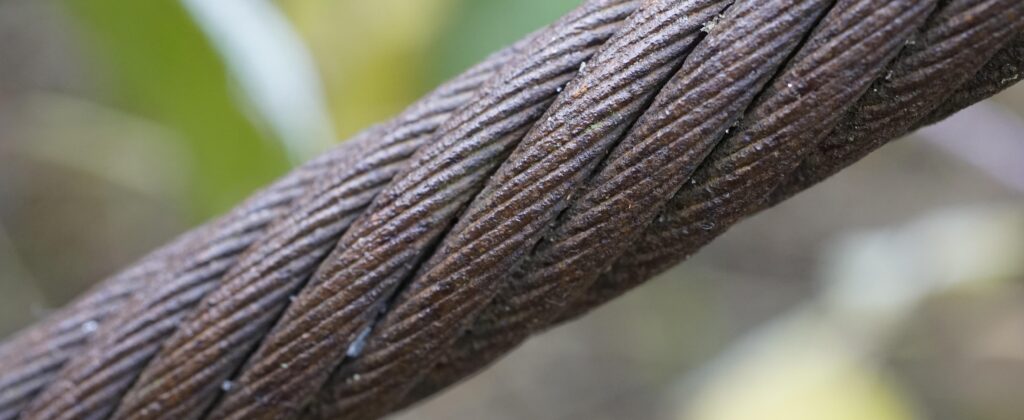
Some work-at-height safety professionals ask: “Has this lifeline expired?” The short answer is that most systems do not have an expiration date printed on them, but they do have removal-from-service conditions. Even if there is no specific expiration date, that does not mean it is valid forever: it means its validity depends on its condition, its records, and what has happened to it, not on a date.
In this guide we clarify three concepts that are often confused: inspecting, repairing, and replacing a lifeline, explaining when action is required in each case.
Does a Lifeline Have an Expiration Date?
In this regard, it depends on the material and the component of each part of the system.
Metal components, such as steel cables, aluminum rails, posts, anchors, or hardware, have no expiration date declared by the manufacturer. Their service life is indefinite as long as they pass inspection and remain in good condition. Therefore, if we find corrosion or deformation, or if the component has arrested a fall, it must be removed from service immediately.
By contrast, textile components, such as harnesses, ropes, webbing, or lanyards, do have a declared expiration. The manufacturer sets a maximum service life from the date of manufacture and another from first being put into service, regardless of whether the equipment has been used or not, because even when well stored, the fibers of the fabric undergo natural aging, so they must be replaced when the period is reached.
Mechanical devices, such as sliding fall arresters, self-retracting lifelines, or trolleys, follow the conditions in their own manual, which usually specifies more frequent inspections and, in some cases, a maximum service life.
In any case, the valid information is always what the manufacturer provides on the system’s identification plate and in the manual. If the plate is illegible or the manual cannot be found, that is in itself grounds for non-conformity.
Service Life of Horizontal and Vertical Lifelines
Both types of lifelines serve the same function, but the working conditions are different, as are the factors that determine their service life.
A permanent horizontal lifeline installed on roofs is exposed to the elements for years. This causes corrosion in the anchors, loss of cable tension, and loosening of hardware from thermal cycling. In coastal or harsh industrial environments, this process accelerates and the inspection interval must be shortened.
A vertical lifeline is subject to wear from use. Every climb causes continuous friction along the cable or rail. In installations where the system is used only occasionally, it suffers less wear, whereas with continuous access, such as wind turbines or telecommunications towers, inspections must be more frequent.
And in confined spaces there is an additional factor: the atmosphere. A system that operates in tanks or sewers can be exposed to chemical agents that attack the material without it being visible to the naked eye. In these cases, inspection is carried out after every use, not every twelve months, or as stipulated by the manufacturer.
We also have to consider the substrate where the lifeline is installed. On fiber cement roofs, the condition of the penetration sealing and the fasteners must be monitored, whereas on deck roofs it is important to verify the watertightness of the anchors to prevent leaks that could damage the roof itself.
Signs That Tell You When to Repair a Lifeline
Repairing a lifeline means replacing a deteriorated component to return the system to service. It is feasible when the affected component is identified, the rest of the assembly is sound, and the replacement part is the manufacturer’s original.
We must step in when we come across any of these situations:
- Loss of tension in the lifeline cable.
- Broken strands, kinks, or deformation in the cable.
- Surface corrosion on anchors or hardware, with no loss of cross-section yet.
- Loose hardware at the fixing points.
- Illegible or damaged identification plate.
- Incorrect operation of the sliding device and the locking mechanism.
It is important to remember that components must always be replaced with original manufacturer spare parts. Certification applies to the system as a whole, not to each individual part, so incorporating parts from another brand can invalidate the conformity of the installation.
When to Replace the Lifeline and Its Components
There are situations in which repair is not an option and it is necessary to remove the system or some of its components:
- It has arrested a fall. There is no exception or visual assessment that counts. Every component involved in arresting a fall is taken out of service until the manufacturer evaluates it, and in most cases it is replaced. The energy absorber, always.
- The textile has reached its date. It is withdrawn even if it shows no damage, since material aging is not always visible.
- Corrosion with loss of cross-section in the cable or anchors, deformation, or damage that compromises its structural strength.
- Lack of traceability. Without a manual, a data sheet, and an original spare part, the system cannot be certified.
- The installation has changed. If the roof or the work route has been modified, or machinery has been added, a lifeline that was initially valid may no longer be suitable for current use even if it is in good condition.
Periodic Inspection and Maintenance Records
The EN 365 standard establishes that lifelines must undergo a periodic inspection at least every twelve months, carried out by a competent person and documented in a record. In installations subject to intensive use or located in especially harsh environments, the inspection interval may be shortened.
In addition to periodic inspections, the user must perform a visual check before each use to detect any defect that compromises safety.
The maintenance record must include:
- Date of commissioning and data on the original installation.
- Each inspection, with date, result, technician, and signature.
- Replaced components, with their reference.
- Any incident, especially fall arrests.
- Modifications to the layout or the installation.
Having this history makes it possible to demonstrate that the lifeline maintains the conditions required to remain in service and facilitates any technical inspection or audit.
If you have an installation of unknown origin, without documentation or without a legible plate, we recommend carrying out a technical assessment before considering replacing it.
Frequently Asked Questions About Lifeline Service Life
Expiration depends on several factors, and not all lifelines follow the same rule. Permanent systems with metal components usually have no established expiration date, as long as periodic inspections are carried out and they are in good condition. However, textile components do have an expiration date set by the manufacturer, and they must be withdrawn once that period has passed.
Typically, inspections are carried out once a year, as established by the EN 365 standard. But it depends on environmental factors, and if use is frequent, the time between inspections should be shortened. In addition, a check must be performed before each use to verify that there is no deformation.
Yes, when the damage is localized and the rest of the system is in good condition and retains its safety function. The repair must be carried out with components from the same manufacturer, since the certificate applies to the system as a whole, not part by part.