


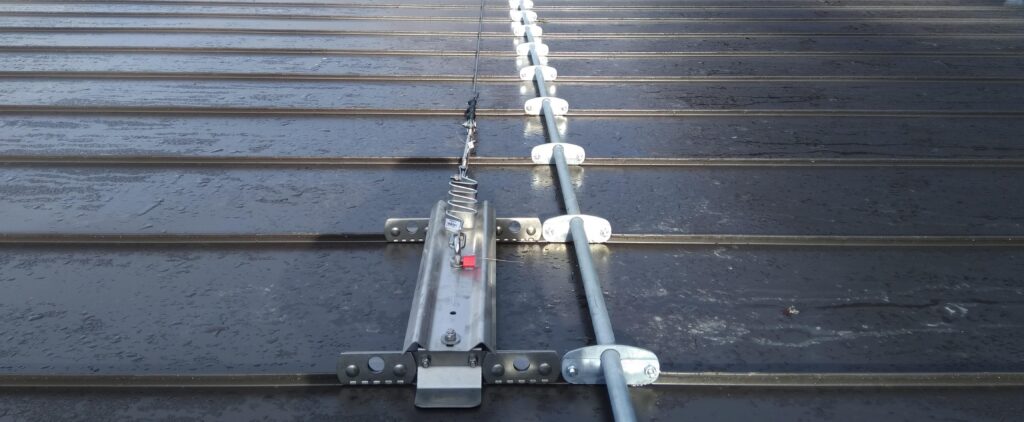
In a risk assessment, it is common for someone to consider a project’s collective protection resolved just because a lifeline is installed. This is a frequent mistake, since a lifeline is personal protection, and confusing the two concepts in a project can leave the real regulatory requirement uncovered. As an installer or safety professional, knowing which category each system falls into determines what you need to combine on site and what you can justify as compliance in an inspection or a bid.
What Sets Personal Protection Apart from Collective Protection
Collective protection acts on the work environment and protects anyone in the area, whether or not they use a particular piece of equipment. A safety guardrail is the most complete example, since once installed, it protects the roof edge without the worker having to do anything. Personal protection, by contrast, depends on the worker wearing personal protective equipment that is properly adjusted. If the PPE fails, is used incorrectly, or is not worn, the protection loses its effectiveness, and that requires specific training, periodic equipment inspection, and checks that it is used correctly at every access.
Why a Lifeline Is a Personal Protection System
A lifeline is a component within a fall arrest system that only works if the worker is attached to an approved harness, connected by a lanyard to a certified anchor point. Without that complete set, the lifeline on its own offers no real protection. That is why it is governed by a different family of standards than guardrails: EN 795 regulates anchor devices according to their type, whereas UNE-EN 14122-3 regulates the design and testing of guardrails as collective protection.
When the Regulations Require Prioritizing Collective Protection
The preventive hierarchy is set by Article 4 of RD 486/1997, which requires prioritizing collective protection over personal protection whenever it is technically feasible. This means that, in work at height on a walkable roof, the first solution to consider is the guardrail, and the lifeline comes in as a complement when the guardrail does not cover the entire route or when the job does not justify permanent protection. The regulations do not rule out personal protection; it is used in cases where collective protection is not feasible, for example, on roofs with no space for a perimeter anchor, very occasional access, or sections where installing a full guardrail would make no sense given the actual frequency of use. You can learn more about this and its exceptions in our article on the difference between collective and personal protection.
Lifeline and Guardrail: How They Are Combined in a Project
In practice, almost no project is solved with a single system. The guardrail covers the walkable perimeter as collective protection, and the lifeline is added for the sections where the worker needs to move outside that protected zone, such as the interior of a roof with skylights or occasional access to a photovoltaic installation. We analyze this combination in more detail, case by case, in portable guardrail vs. lifeline, where we compare when each solution is appropriate depending on the type of roof and the frequency of access.
Properly documenting which of the two systems covers each section of the project also makes paperwork easier when submitting a bid. Showing that the perimeter is protected by a guardrail and that the lifeline only covers occasional access makes it clear that the preventive hierarchy has been followed, rather than giving the impression that the personal solution was chosen because it was cheaper or faster to install.
What to Consider When Choosing Your Protection System
Before choosing one system or the other, make sure you have all the documentation needed for an inspection: testing by an independent laboratory and certification of the system. We must also consider maintenance requirements, since a guardrail is inspected periodically but does not expire, whereas a harness and a lifeline do have expiration dates and require documented replacement, an operating cost worth keeping in mind when comparing both solutions over the medium term. If you have questions about which combination your roof needs, request a quote and we will help you define which part of the project requires collective protection and which part can be handled with personal protection.
Frequently Asked Questions About Lifelines
No, it is personal protection. It only does its job if the worker wears an approved harness attached, by means of a lanyard, to a certified anchor point. If any of those pieces is missing, or the worker is not properly attached, the system stops protecting. This is the main difference from a collective protection system, which does not depend on anyone wearing it.
They are two different ways of protecting against the risk of falling. Collective safety is installed once and protects everyone who passes through the area, without depending on any action by the worker; the clearest example is the guardrail. Personal safety, by contrast, falls on the worker: it requires equipment (harness, lifeline, anchor point), training to use it properly, and periodic inspections, because its effectiveness depends on that whole set working and being used correctly every time.
Yes. Article 4 of RD 486/1997 establishes that, whenever technically possible, collective measures must be chosen before personal equipment. On walkable roofs, this means installing a guardrail as the first option and reserving the lifeline for cases where collective protection is not feasible, for example, because of a lack of space for the perimeter anchor or because the access is very infrequent.