


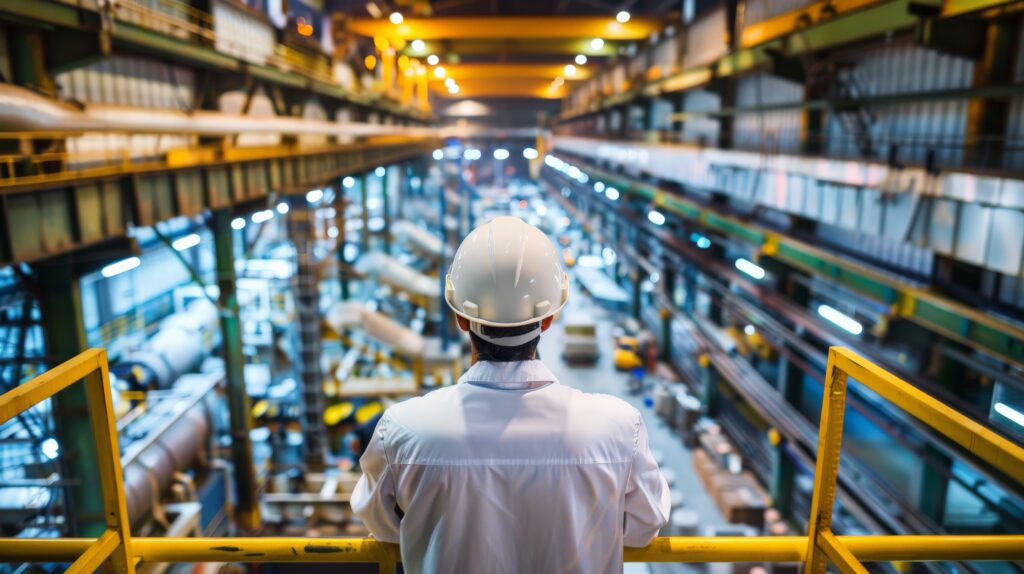
Installing a guardrail, a walkway or a ladder at height is only the beginning; what matters is that they are still protecting 5, 10 or 15 years from now. That is why, in industrial environments, from manufacturing plants to wind turbine maintenance, you need to choose well from day one and look after the system afterward.
At Ypsos Safety we have been manufacturing work-at-height safety systems for years, and we are clear on this: every industry has its own enemies, whether it’s humidity, chemicals, dust, salt… Each one attacks in a different way.
To make your protection last longer, you need to understand this very well.
Why Do Industrial Environments Shorten the Service Life of Safety Systems?
An industrial building is not just any roof; it is a bit more demanding to handle, for the following reasons:
- Constant humidity or condensation that never goes away
- Chemicals that corrode whatever they touch
- Dust and particles that slowly sand things down
- Salty air if you are near the sea
- Extreme temperature changes between day and night, between summer and winter, depending on the geographic area where you are
- Vibrations from machinery that runs nonstop
- Continuous traffic of personnel and heavy equipment
All of this accelerates wear, and if the material you installed is not up to it, the system can fail much sooner than you expected.
An example: A painted steel guardrail that works perfectly in an office building can be rusted within months if you install it in a chemical plant without the right protection.
That is why we insist so much that choosing the wrong material from the start can cut the service life in half and multiply maintenance costs.
Choosing the Right Material for Each Type of Industry
Not all materials hold up equally, since it depends on where you are, what you do there and what the system is exposed to. The keys are:
Aluminum Guardrail (Anodized or Powder-Coated)
It is the best option for the food industry, photovoltaic plants, warehouses and logistics. It works well because it:
- Resists corrosion very well
- Is lightweight and does not load the structure
- Needs little maintenance
- Is perfect for outdoor roofs
Watch out: Don’t use it where there are aggressive chemicals (concentrated chlorides, strong industrial vapors), since it won’t hold up in that environment.
Hot-Dip Galvanized Steel Skylight Protection Net
Perfect for manufacturing industry in general, the energy sector and humid environments without chemicals. Its advantages are:
- Powerful anti-corrosion protection
- Very strong mechanically
Watch out: Special care is needed during installation; be careful if cutting or drilling leaves the steel exposed, since that is where it starts to rust.
Stainless Steel (AISI 304 / AISI 316)
Suitable for harsh environments, such as the chemical industry, coastal areas with salty atmospheres, or areas with processes involving steam, acids, aggressive agents, etc.
AISI 316 is the best option when chlorides are present.
Downside: It increases the initial cost, but it pays off in the long run, since you save on maintenance and don’t have to replace components at every inspection.
Preventive Maintenance
It doesn’t matter how good the material is. Without maintenance, its service life plummets. As for how often inspections should be carried out, at Ypsos we recommend:
- A full inspection once a year in any environment
- Every 6 months in the chemical or food industry, or near the sea
- An extra inspection after heavy storms, hail or extreme winds
What Should You Look at in Each Inspection?
On guardrails
- Anchors firmly fastened
- Corrosion spots
- Play in the joints
- Deformations
On walkways
- Condition of the walkway and the base plates
- Fastenings to the roof
- Slippery areas
On vertical ladders
- Base plates
- Safety cage (hoop cage)
- Anchors
On nets and skylight protection
- Correct tension
- Firm anchors
- Rust
- Deformation from weight
How Do You Clean Them?
It’s very easy: water and mild soap are enough. No abrasive products or strange acids, and the metallic dust that accumulates should be removed so that galvanic corrosion is not accelerated.
If you see any of these things, act immediately and don’t wait for it to get worse:
- Coating that is peeling off
- Rust (even a little)
- Unusual vibrations
- Loose or deformed screws
- Areas worn down by constant foot traffic
Mistakes That Reduce the Service Life of a Safety System
We see this constantly during inspections:
- Cutting guardrails or walkways and not re-protecting the edges → direct rusting
- Not cleaning after construction work, leaving dirt that corrodes
- Installing without checking whether the material withstands the chemicals in your process
- Using the guardrail as a support to rest machinery or heavy loads on
- Not carrying out periodic inspections
- Fastenings that don’t suit the type of roof you have
What Can We Do?
- Choose the material according to your real environment, not the cheapest one.
- Keep the maintenance manual at hand and use it
- Carry out periodic audits (better if done by the manufacturer)
- Replace any damaged component immediately
- Keep a record of all inspections
A well-chosen, well-maintained system can last twice as long and cost you far less in the long run.
Conclusion
The work-at-height safety systems you install have to last for years and keep protecting just as they did on day one. And for that, it is not enough to buy something approved:
- You have to choose the material that fits your environment
- Maintain it preventively
- Detect problems before they become disasters
At Ypsos Safety we don’t just manufacture these systems. We support our customers throughout their entire service life so that their investment keeps protecting with the same reliability as at the beginning, so if you still have any questions, you can contact us.