


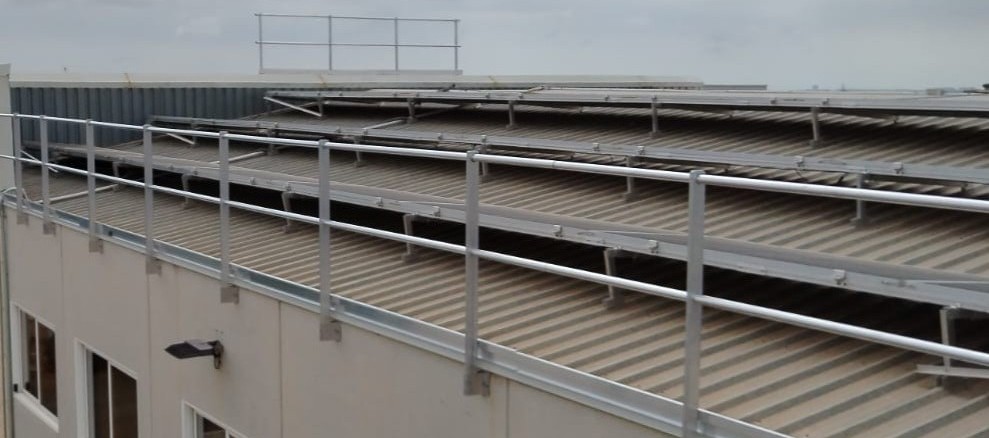
When working on a construction site, whether civil works or an industrial installation, safety in work at height is paramount. Before choosing PPE, or personal protective equipment, we prioritize collective protection, since it protects all workers at the same time and reduces risk from the start.
Guardrails, roof walkways, and safety nets are systems that technicians and installers find on practically any construction site. Choosing the right system for each phase of the project is key to making the protection truly effective.
What Is Collective Protection on Construction Sites?
Collective protection consists of systems designed to protect all workers exposed to a risk, unlike PPE (Personal Protective Equipment), such as hard hats, safety harnesses, and safety boots, which only protect the person wearing them correctly.
Their main purpose is to prevent falls from height and falling objects to a lower level. For this reason, occupational health and safety regulations (Royal Decree 1627/1997, on minimum safety and health provisions at construction sites) establish that collective protection must be implemented whenever possible.
Types of Collective Protection in Construction
Not all construction sites present the same risks, which is why there are different collective protection systems suited to each situation.
Safety Guardrails and Edge Protection
Collective protection guardrails are the best-known system. They are installed on roofs, platforms, walkways, and anywhere there is a risk of falling to a lower level.
Their function is to prevent a person from accidentally stepping into the void. For that reason, they must be a solid structure, of an appropriate height, and correctly fastened according to the type of surface and edge they protect.
Fall Arrest Nets
Collective fall arrest nets are placed directly over fragile roof elements (skylights or roof lights) to prevent a person from falling through the surface itself.
The net does not replace the guardrail; in fact, they are complementary systems, and it is common to find both on the same roof as extra protection against fragile elements. The effectiveness of the net depends on installing the right product for each type of fragile element, as well as the corresponding periodic inspections.
Collective Lifelines
In some situations it is not possible to install guardrails or nets across the entire work area. In these cases, collective lifelines are used: continuous anchor systems, horizontal or vertical, to which several workers can connect at the same time with their personal protective equipment, making it easier to move safely from one area to another.
On each project, it is necessary to study which type of protection is right for each case and use.
Collective Protection at Each Construction Phase
The most suitable protection system changes as the work progresses. What was a good option at the beginning may, as the work advances, need to be replaced with a different system.
- Initial phase: perimeter fencing and systems to delimit work areas are usually installed.
- Structural phase: it becomes necessary to install safety guardrails, fall arrest nets, and protection systems for existing openings.
- Assembly and installation phase: it is common to turn to personal protection systems such as construction lifelines, which will also remain useful later for maintenance work on the building.
Planning collective protection for all construction phases, and not just at the start of the project, is what allows the safety level to stay constant as the risks change.
Collective vs. Personal Protection: When to Use Each
A common question is when to use collective protection and when to resort to personal protective equipment. The regulations are clear: whenever possible, collective protection must take priority.
The reason is simple: a guardrail protects anyone who steps onto a roof, regardless of their experience or whether they remember to put on a harness. A PPE item, on the other hand, only protects the worker if it is used correctly.
This does not mean that the two systems are incompatible. On many jobs it is normal to combine collective protection with personal equipment to offer a higher level of safety, especially for one-off tasks where collective protection is not feasible.
Ypsos Safety Solutions for Civil and Industrial Construction
Every construction site has different needs: protecting the roof of an industrial building is not the same as protecting a tower, a bridge, or a production plant. That is why it is important to have solutions tailored to each project and systems that comply with current regulations.
Ypsos Safety offers collective protection solutions for civil and industrial construction:
- ANANKE safety guardrails, for edge protection on roofs, slabs, and technical walkways.
- PIGNUS safety nets, designed to prevent falls through fragile surfaces.
- ZOIS lifelines, perimeter and vertical, to provide continuous anchorage for crews working or performing maintenance at height.
- PASSUS roof walkways and REBRIK fixed vertical ladders, for safe access to roofs and installations.
Ypsos Safety manufactures these systems and offers technical advice to safety teams and safety coordinators; on-site installation is carried out by authorized installation companies.
The Importance of Proper Planning
Installing collective protection is not just a matter of putting up a guardrail or installing a net. It is necessary to study the risks present in each phase, choose the most suitable system, and verify that the installation is done correctly.
It is important to carry out periodic inspections to verify that all materials maintain their strength throughout the project.
Conclusion
Collective protection is the first option against the risks present on any construction site. Choosing the right system for each phase of the project, installing it correctly, and maintaining it well not only helps comply with regulations but also significantly reduces the likelihood of accidents.
Safety guardrails, fall arrest nets, collective lifelines, and edge protection are part of an effective preventive strategy that improves working conditions and protects everyone involved in the project. At Ypsos Safety we are committed to quality solutions tailored to each project; it is an investment in safety, efficiency, and regulatory compliance.
Frequently Asked Questions About Collective Protection on Construction Sites
Collective protection on a construction site consists of measures that protect all workers simultaneously against the risk of falling to a lower level.
They are safety systems and measures that protect workers simultaneously, without depending on each person using personal equipment correctly.
Safety guardrails, protective nets for skylights and roof lights, roof walkways, or crossovers.
The most common are safety guardrails, nets to cover skylights and fragile elements, and collective lifelines. All of them protect workers against the risks present in each phase of the project.