


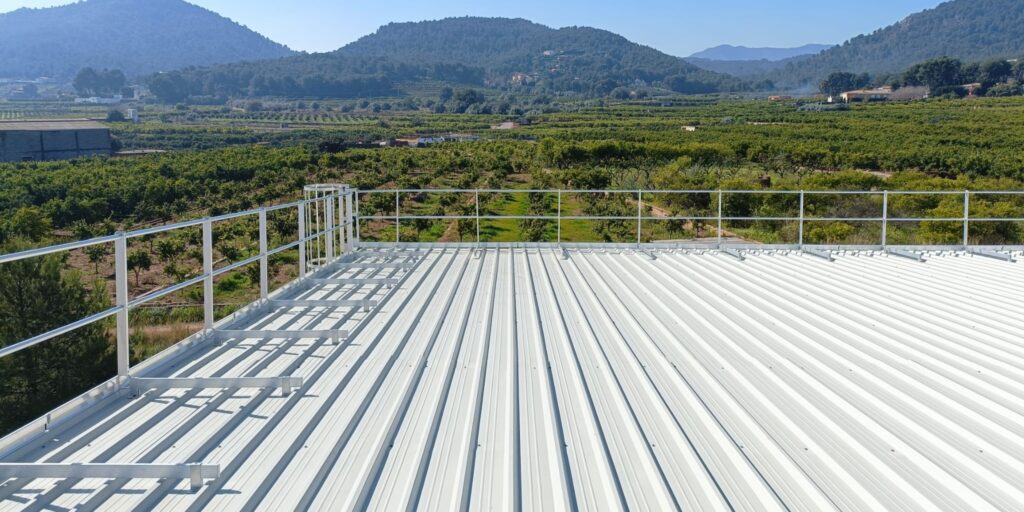
Work at height is classified as the most dangerous occupational activity, with the highest rate of serious and, in most cases, fatal accidents. The main risk is falling to a lower level, but falling tools are also a concern. For this reason, having properly designed and installed perimeter safety systems is one of the most effective measures for protecting workers who walk on industrial roofs, flat roofs, or rooftops.
In this article we explain what these systems are, the types available, how to choose the most suitable one for each project, and what Spanish regulations say about safety in work at height.
What Is a Perimeter Safety System?
A perimeter safety system is the set of practices, systems, and tools that protect the outer part of a physical space at the edge of a roof or on elevated surfaces to prevent falls to a lower level. In security terms, a building’s safety perimeter is the part that forms the boundary between the facilities and the outside.
This type of protection is common on roofs where maintenance work is performed regularly, since it reduces risk without requiring every worker who accesses the work area to depend on a personal protection system, although it is always advisable to combine both types of protection for greater safety.
When a perimeter safety system is installed, it must fulfill three fundamental functions: clearly mark the limit of the safe area, ensure that the worker stays within that limit, and verify its resistance to the mechanical stresses resulting from a possible impact or accidental leaning.
Types of Roof Perimeter Safety Systems
Not all roofs or buildings need the same solution. The most common types of perimeter safety in the industrial and construction sectors are guardrails and lifelines. As mentioned above, these systems can be combined depending on the building structure and the intended use of the roof.
Edge Protection Guardrails
Perimeter protection guardrails are the most widely used and most effective collective protection solution. They offer different anchoring configurations, which makes them very versatile, adapting to any type of roof and acting as a continuous physical barrier that prevents falls into the void. They are available in inclined, fixed, permanently anchored, or freestanding versions for roofs that cannot be drilled.
One of their advantages is the freedom of movement they give workers throughout the protected area, without requiring specific training in their use.
Perimeter Lifelines
When a guardrail cannot be installed, whether for structural or accessibility reasons, a perimeter lifeline is an effective alternative. It consists of tensioned steel cables running along the roof, anchored to evenly spaced supports, to which the worker attaches through a connecting element (lanyard or self-retracting device) to the harness they are wearing.
Unlike guardrails, this system does require the use of personal protective equipment (PPE) and specific training to use it correctly; the worker must be secured at all times for the system to be effective.
How to Choose the Right Perimeter Safety Device
When choosing a perimeter safety system, it is advisable to assess a few factors before carrying out the installation:
- Frequency of roof use. If access is frequent, for example, to carry out regular maintenance of certain installations, collective protection such as a guardrail is usually more suitable. If access is more occasional, a lifeline is usually installed, which is more economical in most cases.
- Roof type and structure. Industrial roofs, fragile roofs, and sandwich panel or metal sheet roofs that may have skylights determine both the type of anchoring and the area to be protected, since it is not just a matter of the perimeter; we must also keep in mind that critical areas on the roof must be protected as well.
- Drilling feasibility. For a roof with waterproofing, the best option is to choose freestanding or counterweighted systems, to avoid compromising the watertightness of the roof.
- Number of simultaneous workers. Lifeline systems have a limit on the number of users that can be anchored at the same time, which must be checked against the manufacturer’s specifications.
In many projects, the most efficient solution combines several of these elements: for example, a guardrail in high-traffic areas and a lifeline at access points to occasional technical equipment.
Regulations Applicable to Perimeter Protection
The installation of perimeter protection on roofs in Spain is regulated mainly by Royal Decree 1215/1997, under the Occupational Health and Safety Law, which establishes the minimum safety and health provisions for the use of work equipment by workers, and by Royal Decree 486/1997, on minimum safety and health provisions in the workplace, which makes it mandatory to protect openings and drops with a risk of falling from a height of 2 meters.
On the technical side, systems must comply with the applicable UNE-EN standards according to their use and type:
- UNE 14122-3, for perimeter protection guardrail systems.
- UNE-EN 795 and UNE-EN 17235 (2025), for anchor devices and lifelines.
In addition, when the installation or maintenance of these systems is performed by an external company, it is mandatory to apply the Business Activity Coordination (CAE) procedures, in accordance with RD 171/2004, ensuring the proper exchange of risk information between companies.
Ypsos Safety Perimeter Solutions
At Ypsos Safety we design, specify, and manufacture perimeter safety systems tailored to each type of roof, from logistics warehouses to photovoltaic and wind installations. Our catalog includes fixed, freestanding, and inclined edge protection guardrails manufactured in accordance with the UNE 1422-3 standard, and perimeter lifelines certified in accordance with UNE-EN 795.
We have a trained technical team that provides personalized advice for your type of roof, determining which type of system is safest and most efficient for your project.
Frequently Asked Questions About Perimeter Safety Systems
When we talk about the types of perimeter safety, we can distinguish between permanent systems, which can be safety guardrails or lifelines, and temporary systems, which include nets or perimeter edge protection systems (SPPB).
Perimeter safety systems act as collective protection; they delimit the risk zone, behaving like a filter that regulates who or what crosses the line.