


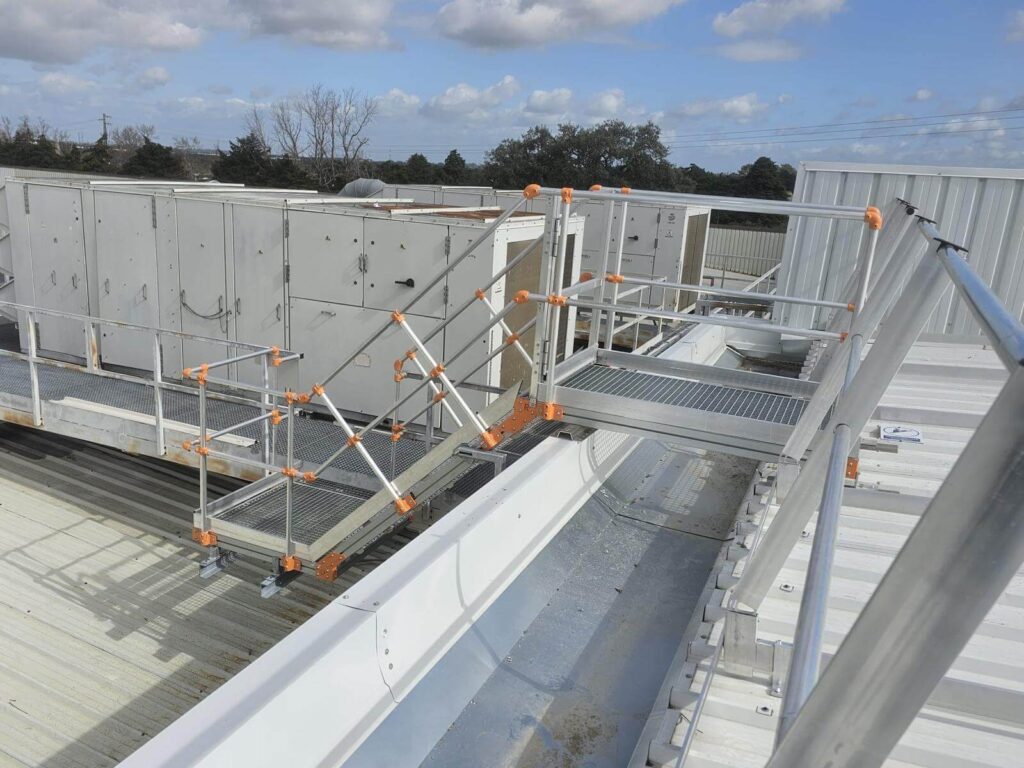
In daily site work, both in industrial maintenance and in the field of prevention, it is very common to come across systems such as protection nets, fixed ladders, guardrails, lifelines, etc. We wonder whether they are really safe, whether they comply with the work-at-height regulations or, otherwise, whether they are reliable.
Every day, safety technicians, installers and maintenance managers have to evaluate these systems, whose main function is to protect against a fall. That is why having a clear, technical and practical method is essential for making good, informed decisions and ensuring the safety of every installation.
What Do the Regulations Say About Work-at-Height Safety Systems?
To properly evaluate a work-at-height safety system, the first thing we need to know is what the regulations applicable to that system require.
Each type of collective protection is governed by specific requirements that define its design, materials, strength and method of installation. This is neither optional nor open to interpretation: the standard sets minimum conditions for that product to be fully safe.
For example:
- Guardrails: they must withstand horizontal and vertical loads, meet a minimum height and respect set distances between elements or profiles, and have the right fasteners for each surface or roof.
- Protection nets: they have defined requirements for impact absorption, mechanical strength and defined mounting methods, as well as distances between anchors and elevation by means of rubber spacers to prevent wear.
- Fixed ladders: they must meet regulatory dimensions, specific materials, structural strength, permitted angles of inclination and safe access conditions.
Understanding these sections is essential to complying with safety regulations. A robust system is not necessarily a safe system if it has not been designed and tested as its corresponding standard indicates. The regulations require ensuring that, in the event of a fall or impact, the equipment performs correctly and has no failure in use.
Clear Signs That a Product Does Meet the Regulations
When evaluating whether a work-at-height safety system is reliable, there are several objective signs that indicate its conformity.
- Declaration of conformity or fall protection certificate: this is the official document confirming that the product has been designed and manufactured in accordance with the applicable regulations.
- Installation manual: a fall arrest system that complies with the regulations must include an assembly or installation manual, clearly indicating what surface to fasten it to, which anchors must be used in each situation and the conditions needed to ensure its strength.
- Test report: every system that complies with the regulations has passed mandatory tests in accredited laboratories or bodies. These tests check loads, impacts, dynamic behavior and real-world strength.
- Maintenance manual: if it does not include maintenance instructions, the durability and reliability of the system cannot be guaranteed.
- Manufacturer identification: many systems include technical references, QR codes, plates or labels that let us know the model, manufacturing date, expiration or other relevant data, making tracking easier.
- Complete documentation delivered to the installer or client: if technical documentation is missing or nonexistent, that system cannot be considered compliant with its standard.
These signs make it possible to quickly tell a reliable system from one that is not. If a product lacks its certificate, documentation or test evidence, it should not be considered fit for installation at height.
Once we confirm that it complies with the regulations, the next step is to check that the installation maintains these safety guarantees.
How to Check That the Installation Maintains Compliance
Even when a product is certified, an incorrect installation or assembly can turn it into an unsafe system. Verifying the installation is as important as inspecting the product, and for that you need to follow certain guidelines and ask yourself some questions, such as:
- Do the dimensions match those in the assembly manual? To check, you need to see whether the actual height of the guardrail, the width or the slope of a ladder, and the fastening distances all match.
- Are the anchors as specified? Replacing a specified anchor with a similar one changes the final strength of the system.
- Is the installation firm and free of deformation? If it shows corrosion, dents, play or loose parts, these are warning signs.
- Were the step-by-step assembly procedures followed? Skipping a step of the assembly or adapting parts to the site compromises the safety of the system.
- Is there a record of periodic inspections? Depending on the installed system and its use, the regulations require regular inspections.
- Have incidents been documented? Every change must be recorded to ensure traceability.
When a system is properly installed and well maintained, its protective capacity is preserved throughout its service life. When it is not, its reliability decreases, even if it is certified.
How Does Ypsos Ensure Regulatory Compliance?
At Ypsos, the regulations are followed to the letter, starting with the product design itself, making sure every detail of every requirement is met. And before a product is marketed, the mandatory tests are carried out to validate its strength and safety.
Each model goes through an internal check before manufacturing, thus maintaining quality standards.
This is complemented by the documentation delivered to the customer, ensuring transparency and trust.
Evaluating a work-at-height safety system becomes simpler by following a clear method: understand the regulations, identify the signs of conformity, verify the installation and trust established manufacturers such as Ypsos. This is the best way to ensure a safe working environment.
Conclusion
It is very important for a manufacturer, and for anyone working at height, to know not only their product well but also its regulations, to know how to identify signs of conformity and to always verify that the installation has been done correctly. Applying this method helps you work in a safe environment and make informed decisions.
If you need advice or have questions about the regulations or the installation of any system, you can contact us. We will be happy to help.