


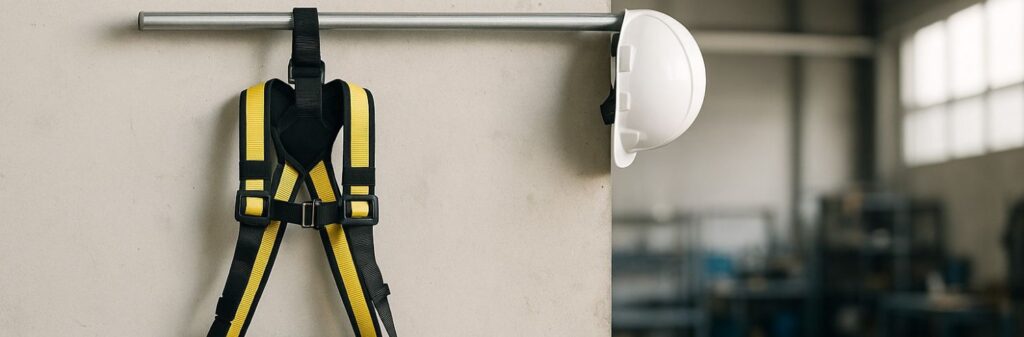
Tips to Avoid Improper Harness Fit
Sometimes, especially in the workplace, there are actions that are believed to be correct out of habit, because they’ve been done that way “all your life.” This happens a lot with the use of PPE. Even though it is part of many workers’ daily routine, the fact that it was never explained properly, or never explained at all, can lead to a nasty scare. Maybe you’ve been working at height for years and simply do it “the way you always have,” or maybe it’s your first day and nobody has explained it to you. Whatever your case, today we have some tips that will help you work more comfortably and, above all, more safely.
What Are the Consequences of Wearing a Poorly Adjusted Harness?
The first thing to make clear is that wearing a safety harness that is not properly fitted creates a false sense of security, which is even more dangerous because that confidence makes you let your guard down: you pay less attention to risks, move faster without care, and get closer to the edge.
What can happen as a result of these actions, simply from not taking a minute to adjust the harness correctly, is far more serious than it seems. The consequences can be:
- You can trip or slip on the harness itself: if the straps are poorly positioned or too loose, the harness can move around too much, catch on tools, a corner, or something protruding, and make you trip.
- The safety harness can press where it shouldn’t, on areas of the body such as the groin or thighs, causing cramps or injuries.
- If a fall occurs and the fall protection harness is poorly fitted, the impact will be absorbed by a part of the body that isn’t meant to take it, causing more pain than it should and severe whiplash.
- It can aggravate harness syndrome: when it is adjusted where it shouldn’t be, the pressure builds up faster and in worse areas.
- If the harness is loose, you can lose mobility or lose your balance during the fall. If you are in narrow areas or near obstacles, you could hit something, or even fall completely by slipping out of the harness.
Key Steps to Adjust Your Harness Correctly
Putting on and adjusting a harness is not a complicated job. It is a three-minute task that can make a big difference. Here are the key steps to stay safe when working at height:
- Lay the harness out fully: The first step to doing it right is simple. Spread the harness out to make sure none of the straps are crossed.
- We start by putting on and fastening the upper part first. We hold the harness by the back ring and bring the shoulder straps up over the shoulders. It should go on like a jacket, as if you were putting on a vest, without crossing the straps. That way everything stays in place.
- We fasten the sternal connection (the chest area) first. With the shoulder straps properly in place, we fasten the front part. Next, the leg straps are buckled.
- The fall protection harness must be adjusted properly once everything is buckled. The order is the opposite of how we put it on: first we tighten the leg straps well, and then the upper part is adjusted. Check that the ring is centered.
After adjusting both the lower and upper parts, there is a simple way to check that it has been tightened correctly: we slide the palm of the hand between the leg and the strap, which should go in with some ease. Then we make a fist, which should not be able to come out of the safety harness if we try to pull it out.
Mistakes Made Every Day (and How to Avoid Them)
When these topics are discussed, they can seem very obvious, but when it comes down to it, the same mistakes are always made.
- Leaving the fall protection harness loose to work more comfortably. It is buckled but not adjusted. Although in the moment it feels more comfortable not to be so tightly strapped in, in the long run, even if no fall occurs, it can cause injuries from chafing and more serious wounds.
- The exact opposite: adjusting it too tightly, which can leave you with little or even no mobility to work safely. To avoid this case, or the previous one, you should use the “trick” of sliding in your palm and trying to pull out your fist that we explained earlier. And the worst part is that, in the event of a fall, both a loose fit and an excessively tight one can cause even more harm.
- Not checking for cuts or wear, or whether it has expired. Many workers at height use the same harness every day without checking whether it is in good condition, something that could even cost you your life. The worker must also carry out the inspection daily before using PPE, since it is their life at stake, and if any fault is observed, they must report it so it is replaced immediately. It is very important to check whether the PPE we use is certified.
- Leaving it on the ground where it gets dirty or deteriorates. The workday ends and the safety harness is left lying anywhere; this carelessness gradually ruins it. It should always be stored in a clean, dry place.
How Often to Inspect Your Harness and Who Should Do It
It is important that every user inspect the harness before each use, checking that the stitching is intact, that there are no cuts or burns, that it is not wet, and that its label is visible so you can confirm it has not expired.
In addition to this daily PPE inspection, there must be at least one periodic inspection every twelve months by a competent person (usually, though it also depends on the manufacturer’s instructions, which may specify a shorter period). If an accident or a fall has occurred, or if the fall protection harness has suffered any damage, it must also be inspected by a competent person.
PPE must always be stored in a clean, dry area, avoiding moisture and mold.
Conclusion
It is important to remind ourselves from time to time how necessary it is to be careful with the use of PPE. As we mentioned at the beginning of the article, ways of working often become normalized, or we get overconfident because it’s “what we’ve always done.” In this kind of work, we can’t afford that luxury.
In work at height there is no margin for error, because we are risking something as valuable as life itself.
If you have the slightest doubt, such as “Is this ring right?” or “Is this strap twisted?”, ask or check it again. If you are not sure how it is done, insist on being properly shown, or on receiving work at height training.
At Ypsos, we work every day to do our part by explaining how to avoid these kinds of mistakes and sharing more tips on safety at height on our blog. If you have any questions, please feel free to contact us.