

Working on roofs is one of the activities with the highest accident rates in the construction, industrial maintenance, and logistics sectors. The problem gets worse when there are dome skylights or skylights: many workers perceive them as sturdy surfaces when they are actually critical points of fragility.
Protection nets on roofs are a fundamental collective protection system, but it must be clear that not all nets are valid for every situation. An incorrect choice can create a false sense of security and leave workers exposed to real risks.
In this post we analyze and explain what types of safety nets exist, when to use each one, and what technical factors must be analyzed before selecting them.
Do All Safety Nets Serve the Same Function?
No. The function of a fall protection net is to prevent people or materials from falling from an elevated plane, mainly roofs, or to arrest a fall if the element breaks when stepped on accidentally (for example, a dome skylight).
On roofs and skylights, nets are designed to prevent:
- Falls to a lower level through fragile dome skylights
- Falls from the edges of the roof during maintenance work
- Accidents caused by breakage of aged or deteriorated translucent panels; keep in mind that over time it is hard to tell the walkable part of a roof (panel or sheet metal) from a translucent one.
The most common mistake is assuming that any net is valid for any application. Installing a net without analyzing how the roof is used, the type of dome skylight, or the environmental conditions can lead to:
- Excessive deformation on impact
- Premature failure due to corrosion or degradation
- Systems that make later maintenance difficult
Collective protection on roofs must be designed as an integrated system, not as an add-on without technical criteria.
How to Choose a Protection Net
Before deciding which type of net to install, it is essential to carry out a technical analysis that includes:
1. Roof Characteristics
- Type: metal, sandwich panel, fiber cement, metal deck, flat roof, gravel
- Slope and geometry of the surface
- Load-bearing capacity of the supporting structure
2. Characteristics of the Skylight
- Material: polycarbonate, fiber-reinforced polyester, fiberglass
- Condition and age
- Dimensions and existing fastening system
3. Use and Frequency of Access
- Occasional access or regular worker traffic
- Maintenance activities: HVAC, photovoltaic installations, exhaust systems
- Expected dynamic loads
4. Environmental Conditions
- Industrial environments with aggressive chemical agents
- Coastal areas with high salinity
- Prolonged exposure to UV radiation
- Accumulated dirt and dust
5. Maintenance and Service Life of the System
- Ease of periodic visual inspection
- Need for future removal or replacement
- Compatibility with other protection systems
Only after this technical analysis can the most suitable type of net be properly defined for each specific situation.
Types of Roof Protection Nets
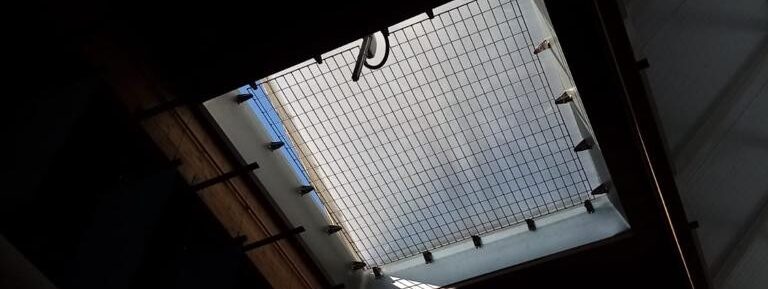
Fall Arrest Nets Under Dome Skylights
They are installed on the underside of the skylight, creating a safety net that acts as a catch system if the translucent material breaks.
Recommended applications:
- Existing dome skylights where work from above is not possible
- Areas with occasional access
- Operating industrial facilities where activity cannot be stopped
Technical requirements:
- Proper tensioning and anchoring to strong structural elements
- Verification of the energy absorption capacity in the event of impact
- Compatibility with the dimensions and geometry of the skylight
- Custom manufacturing depending on the dimensions and shape of the dome skylight
Protection Nets Over Dome Skylights or Skylights
They are installed on top of the dome skylight or skylight, preventing direct access to the fragile surface and acting as a preventive physical barrier.
It is important to stress that these are not walkable surfaces, meaning they must not be stepped on.
Recommended applications:
- Roofs with regular maintenance staff traffic
- Frequent work on the roof
- When protection against direct impact is required
Technical advantages:
- Prevent direct contact with the translucent panel
- Distribute the load over a larger surface
- Make it easier to mark the risk area
Technical Recommendations from OHS Experience
As an occupational health and safety technician specialized in work at height, these are the key recommendations:
- Do not prioritize economic criteria alone when selecting the system
- Use certified systems designed specifically for roof protection, in accordance with UNE-EN 14963:2007.
- Verify the technical compatibility of the net, anchors, and supporting structure through calculation, passing the corresponding tests .
- Design based on the actual use of the roof, not just the initial theoretical risk
- Document the installed system and establish a periodic inspection plan
- Train workers on the limitations and correct use of the system, as well as on how to go through an inspection.
A well-chosen safety net not only prevents accidents, it also makes safe maintenance easier and contributes to the durability of the installation.
Conclusion
Selecting a protection net for dome skylights is a technical decision that directly affects workers’ safety. There is no universal solution: each type of net responds to specific needs and conditions.
A prior analysis of the environment, the use, the characteristics of the roof, and the condition of the existing elements is essential to select the most suitable system. Investing in well-designed collective protection is not an additional cost, but an investment in safety, regulatory compliance, and effective risk management.
Effective prevention is based on well-founded technical decisions, not improvised solutions.
If you have any questions, you can contact us.