


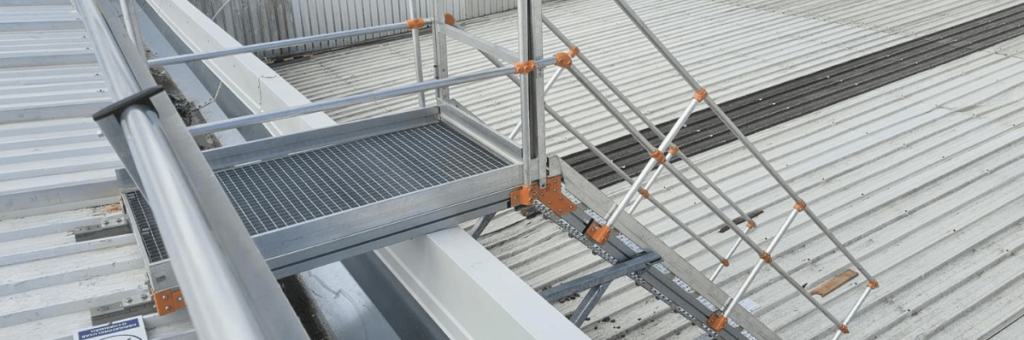
Safety in the work environment is a fundamental priority. One of the most important points is ensuring safe access to machines and elevated areas.
In this post we will discuss the different types of access ladders regulated under different standards, their features, applications, and safety considerations.
Vertical Ladders
Vertical ladders are rigid, fixed structures that provide direct access to elevated areas. Their design is simple but robust. They are generally made of metal to ensure durability and resistance to adverse conditions, since these systems are usually installed outdoors or in areas where corrosive elements may be present, so they can also be found in other materials such as FRP.
This type of safety system is commonly used in industries where space is limited and safe access to upper levels is needed, such as production plants, telecommunications towers, and storage silos, among other uses.
The manufacture of these systems has minimum safety requirements:
- Minimum width: Must be at least 400 mm to ensure comfortable and safe access.
- Rung spacing: The spacing must be uniform, commonly 280 mm.
- Fall protection: Ladders taller than 3 m must be fitted with elements that protect against the risk of falling; these can be safety cages or harness systems.
- Rest platforms: Recommended for ladders taller than 9 m to prevent user fatigue.
Step Ladders
Also known as self-supporting ladders, they have an “A”-shaped structure that provides stability without the need for additional support. They are designed to be foldable and portable.
They are ideal for temporary access and maintenance work in elevated areas where it is not possible to install a fixed ladder.
They also have minimum manufacturing requirements:
- Stability: They must have locking elements to prevent them from folding accidentally during use.
- Non-slip material: The steps will contain non-slip materials to prevent slipping.
- Maximum height: The standard specifies the maximum height depending on the design and intended use to ensure stability.
Fixed Inclined Ladders
These ladders are designed with a slope less steep than vertical ladders, providing more gradual and safer access. Their structure can vary, including handrails and wider treads.
They are used in areas where access is frequent and safety is a priority, such as machinery platforms, roofs, and processing plants.
Their safety requirements are as follows:
- Maximum slope: Generally, it must not exceed 45° to ensure safe access.
- Handrails: They must be fitted with handrails on both sides to give the user this additional support.
- Non-slip treads: To prevent accidents, the treads will be made of non-slip materials.

Stair Ladders
Stair ladders are similar to ladders, but they are designed to provide more comfortable and safer access with wider, more uniform treads.
They are mostly used in industrial and commercial applications where safe access to elevated work areas is required, generally factories and warehouses.
Safety requirements:
- Tread width: Must be sufficient to allow secure foot placement.
- Material: Must be made of strong, non-slip materials.
- Handrails: Must be installed for heights above 1 m.
Mobile Access Ladders
These ladders are manufactured with wheels to allow mobility, and include top platforms and handrails for greater safety.
They are common in warehouses and distribution centers, where frequent access to elevated areas is needed.
Safety requirements:
- Wheels with brakes: They must have brakes to secure the ladder during use.
- Handrails and platforms: It is very important that they include handrails and non-slip platforms for user safety.
- Stability: Their design must be focused on preventing tipping.
General Safety Conditions
Regardless of the type of ladder, the standard establishes a series of general safety conditions that must be met:
- Regular inspections: A very important aspect is to carry out periodic inspections to ensure that the ladders are in good condition and pose no safety risks.
- User training: Users must receive adequate training on the safe use of ladders, including how to prevent falls and handle loads while climbing or descending them.
- Preventive maintenance: Regular maintenance must be carried out to identify and correct wear on the ladders before it becomes a hazard.
In short, understanding the different types of ladders and their specific applications will allow us to make the most suitable choice for our needs, reducing the risk of accidents and improving work efficiency. It should be remembered that each manufacturer will have its own particular specifications, so in addition to the aforementioned standard, it is advisable to take into account each manufacturer’s manuals and technical data sheets.