


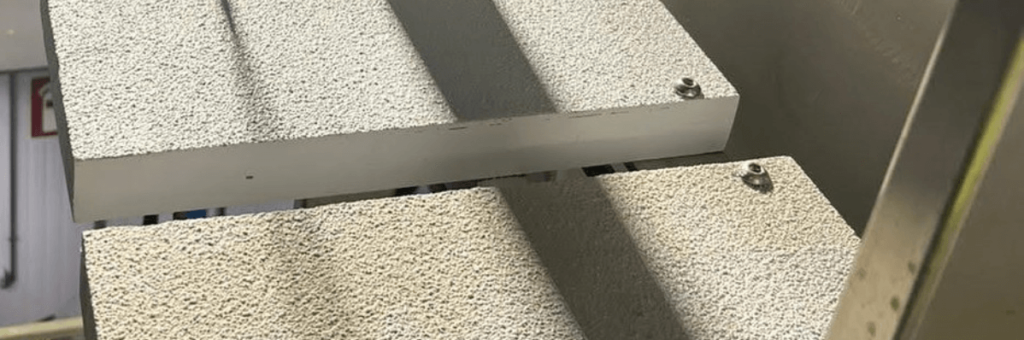
Sometimes it is necessary to install special measures to increase safety and make work easier for users at height. This is the case with hinged landings or movable landings on ladders.
In this week’s post, we will take a closer look at them: the regulations that govern them, the uses they are intended for, and the materials used to manufacture them.
REGULATIONS
Royal Decree 486/1997 establishes the minimum safety and health provisions in the workplace, which lists a series of general mandatory measures for the use of ladders.
The measures for installing these safety elements are regulated by the UNE-EN ISO 14122-4 Fixed ladders standard and the UNE-EN 14396:2004 Fixed ladders for manholes standard.
These standards contain the various requirements for specific dimensions, shapes, lengths, materials, and their distances to other elements, which make our safety system comply with current regulations.
With regard to design, the UNE-EN ISO 14122-2 and UNE-EN ISO 14122-3. standards must also be taken into account.

Use
Referring to the UNE-EN ISO 14122-4 standard, when we install a vertical, continuous access ladder, we have to take its height into account. Ladders over 10 meters high must have fall arrest devices, and landings or intermediate platforms must be placed every 6 meters, including the following:
- Intermediate platforms
- Rest platforms
- Intermediate landings
- Movable landings
l
This time we are going to focus on movable landings. These landings are installed to let the user rest and change flights. They must be 4 meters or more in width and 3 meters or more in length when they are one-piece. If they have two parts, the width must be 1.3 meters or more, with the same length.

This type of hinged landing can be used, for example, in factories dedicated to food production.
When a maintenance technician has to reach the top of a machine for repair, and it is more than 10 meters high, the only means of access is a ladder anchored to the wall.
And as we mentioned before, landings are needed every 6 meters to make the user’s work easier and to make the most of the limited space in certain factories.
Besides being installed in factories, movable landings on ladders are used in other places, such as:
- Stacker cranes.
- Silos.
- Industry in general.
- Shafts.
- Mines.
We add to these all kinds of places where safe access is difficult or where space is very limited.
MATERIALS
As mentioned above, movable or hinged landings can be installed in silos or shafts, places where there is a risk of corrosion. With this in mind, the best material currently available for manufacturing landings is FRP, a plastic material reinforced with fiberglass. This makes it lighter in weight and therefore ensures we meet the weight limits the regulations require.
Besides being suitable for silos or shafts, this material is advantageous in:
- Marine environments.
- Chemical plants.
- Wastewater treatment plants.
- Manholes or inspection shafts.
- Food factories, where production processes can corrode other materials.
In short, movable or hinged landings for ladders can be very useful for making things easier and ensuring user safety in hard-to-reach areas or areas with limited space.