


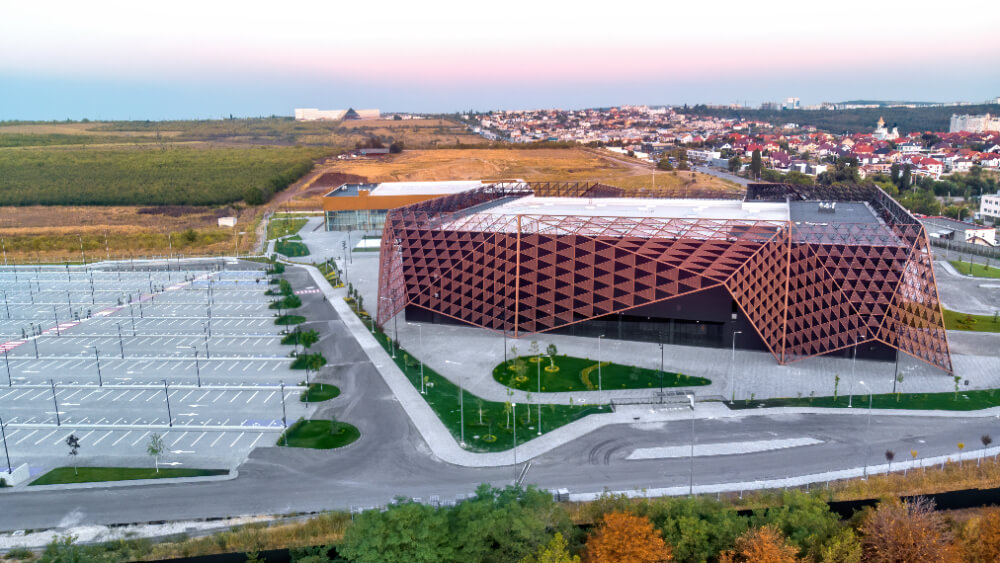
In a shopping mall we can find numerous activities and leisure areas that we all know, but there is something most people don’t know about: its roof.
In this post, we will explore what can be found on shopping mall roofs, how to access them, and what safety measures must be implemented so that they are both accessible and safe for all users who need to go up to carry out any work.
What Can We Find on Shopping Mall Roofs?
Shopping malls have numerous functional installations on the roof, which are usually designed to ensure the efficient and sustainable operation of the building.
These installations can include:
- HVAC and ventilation systems
- Cooling towers: Used to dissipate the heat generated by refrigeration systems.
- Exhaust systems: Fans and ducts to remove stale air or contaminants from the building.
- Air conditioning units (HVAC): Large equipment that regulates the temperature and air quality inside the mall.
- Power generation and management
- Solar panels: Generate clean energy to reduce electricity consumption from the grid and improve sustainability.
- Cogeneration plants: In some cases, systems are installed to generate electricity and heat efficiently.
- Lighting: Exterior light fixtures for security and visibility at night.
- Water management
- Rainwater harvesting systems: Tanks or gutters that collect and store water for reuse in irrigation or cleaning.
- Storm drains: Networks that channel rainwater to prevent flooding and structural damage.
- Telecommunications infrastructure
- Telecommunications antennas: To ensure mobile connectivity and internet in the mall.
- Wi-Fi systems and security cameras: Access points for surveillance and communication.
- Additional technical spaces
- Backup power generators: Diesel or gas engines that start up during power outages.
- Electrical systems: Substations or transformers that distribute power throughout the building.
- Storage areas: Spaces for maintenance equipment and tools.
These installations are usually designed so that they do not interfere with the aesthetics of the mall, often hidden by architectural structures or accessible only to authorized personnel.
Access to Shopping Mall Roofs
Access to shopping mall roofs is usually restricted to professionals who need to perform maintenance, inspection, installation, or similar work.
To access them, it is normally necessary to be equipped with personal protective equipment suited to the work to be done.
In addition, depending on the condition of the roof and the systems on it, fall arrest safety devices, among others, must be installed.
Below are some of the reasons for accessing shopping mall roofs:
- Equipment maintenance: Inspecting, cleaning, or repairing systems such as HVAC, solar panels, drains, or electrical equipment.
- Safety inspections: Assessing the structural condition of the roof, identifying leaks or damage, and verifying the functionality of guardrails and protection systems.
- Equipment installation: Installing new devices such as antennas, security cameras, lighting, or ventilation systems.
- Cleaning: Removing accumulated debris, leaves, or dirt that can block drains or affect the performance of installed systems.
Once the reason for access has been identified, a series of steps must be followed:
- Prior authorization: Permits issued by the mall management and, in some cases, by local authorities are required.
- Prior planning:
- Carry out a specific risk assessment to identify potential hazards.
- Have an approved work plan.
- Fall protection:
- Mandatory use of personal protective equipment (PPE) appropriate to the work to be done.
- Presence of fall protection such as guardrails, safety nets, or certified anchor points.
- Personnel training:
- Only trained and experienced personnel should access roofs.
- Training in work at height, rescue, and use of PPE.
- Supervision and communication:
- Have supervisors and a direct line of communication during the work.
- Clear signage to prevent unauthorized people from entering the area.
- Prior inspection:
- Verify that the roof surface is safe and that there is no structural damage that compromises stability.
In short, accessing shopping mall roofs must be a carefully planned activity, carried out by trained professionals, and always with appropriate safety equipment. Safety and risk prevention must be a priority at all times.

Fall Protection on Shopping Mall Roofs
As mentioned above, access to shopping mall roofs must be planned and must meet a series of requirements to be done safely.
In this section we will focus on fall protection, which collective protections must be installed, which PPE is necessary, and which safety systems we must install depending on the elements on the roof.
Fall Protection Systems and Devices
- Safety guardrails: Installed around the entire roof to prevent falls at the edges.
- Safety nets: Placed beneath work areas exposed to fall risks.
- Safe access systems:
- Fixed ladders with protection (safety cages).
- Crossovers or walkways with guardrails to cross unstable or fragile surfaces.
- Lifelines:
- Horizontal: Installed along the roof to provide a continuous anchor point.
- Vertical: On access systems, such as ladders.
- Certified anchor points: Fixed or mobile, designed to withstand the load of a fall.
- Safety nets: To protect users from falling through skylights and roof windows
Personal Protective Equipment (PPE)
When collective measures cannot be implemented, personnel must be equipped with:
- Safety harnesses: Approved under local and international standards.
- Connecting elements: Slings or double-hook lanyards.
- Safety helmets.
Safety Training for Work at Height
- Workers must receive specific training in work at height, including:
- Proper use of PPE.
- Identification of roof hazards.
- Rescue and first aid procedures.
- Regular drills to ensure emergency preparedness.
Inspection and Maintenance
- Periodic inspections: Verify that fall protection measures (guardrails, anchor points, lifelines) are in good condition.
- Immediate repairs: Fix any defect that could compromise safety.
As we have seen throughout this article, shopping mall roofs have numerous installations that need maintenance and periodic inspections, and therefore require professionals to access them. For them to do so safely, they must have a series of fall protection measures, devices, and systems to avoid possible risks of falling to a lower level.
If you would like to learn more about roof safety, you can visit our work-at-height safety blog.