


In previous posts we have discussed skylights and the importance of choosing the right safety systems based on the type of roof we are working on.
Today we will talk about choosing safety nets to protect skylights, depending on the different types of roofs.
Fall Protection for Roofs with Skylights
As we already know, work-at-height safety systems are designed and manufactured to protect against elements that can create a hazard, regardless of the type of roof we are working on.
In these cases, manufacturers take into account the different construction elements of roofs in order to offer a solution for each one, which is why there are times when custom-made systems are even required.
What Types of Roofs Might We Encounter?
Among the variety of materials used to finish roof surfaces, the most common ones are:
- Sandwich panel.
- Single or trapezoidal metal sheet.
- Waterproofed roofs.
- Asphalt membrane roofs.
- Concrete roofs.
- Deck-type roofs.
As noted, these are the most common, although other roof finishing materials may also be found.
In this case, it is not only the roof material that matters; we must also pay attention to a very important aspect: the type of skylight found on the roof.
As we may recall from previous posts, skylights can be flat or domed skylights. Therefore, choosing the right safety system will depend on the type of skylight we need to protect and, in turn, the type of roof.
Why the Roof Matters When Choosing the Right Safety System
Although there are various standardized solutions on the market for protecting skylights, not all of them work for every type of surface or every type of translucent panel. Therefore, before choosing these systems, we first need to be clear about which ones suit our particular situation.
For domed skylights, we covered the different types of solutions in previous posts, depending on the roof and the type of element to be protected.
However, the situation changes when we face the protection of flat skylights. Here, the first thing to consider is that the roofs where we usually find these elements are sandwich panel and single or trapezoidal metal sheet roofs.
These types of flat skylights are practically impossible to find on other roofs because, given their finishes, domed skylights are usually installed instead.

Fall Protection for Flat Skylights
As noted, for flat skylights the choice of safety system is easier because the roofs where they are installed allow anchoring elements to be fixed directly to them.
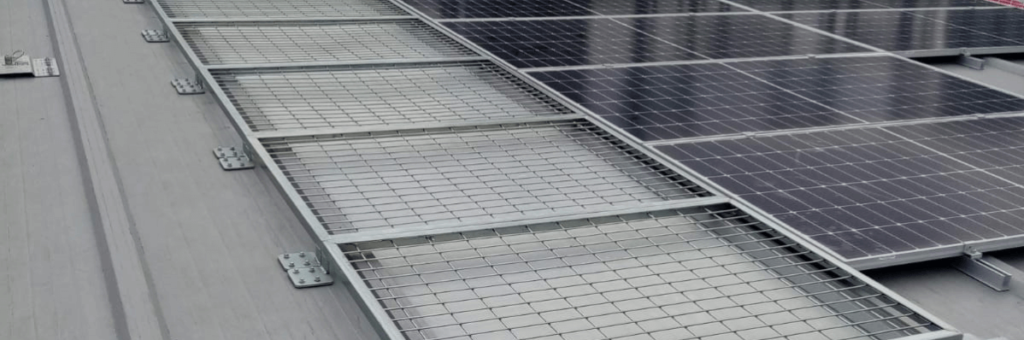
Therefore, the safety system to install, in our case, would be the Pignus Panel and Plate protection nets. These solutions would be fixed directly to sandwich panel and single sheet roofs, respectively, with the corresponding installation variations for each, as indicated in our manuals.
But even though choosing the safety system is so straightforward, there are other factors that may lead us to opt for other types of systems or to supplement these.
Protection Against the Risk of Falling Through
The first thing to consider is two distinct aspects of protecting these elements. One is protecting them against the risk of falling through, which would prevent a fall into the void or onto elements that may be located below the skylight, such as shelving, structural elements, or machinery, which could cause the same kind of harm as a fall from height.
Protection Against the Risk of Falling
On the other hand, we can protect these elements against the risk of falling with alternative systems such as counterweighted guardrails or temporary protection nets on movable counterweighted frames. The difference in this case is that, if the system fails or the user acts irresponsibly, the risk of falling through would still exist.
Enabling Passage Over Skylights
Another case we may encounter is the routes that often have to be set up on roofs to reach repair or maintenance areas.
In these situations, in addition to the previous solution of protecting the translucent panels with safety nets, it is possible to install crossover walkways above them.
The net prevents the risk of falling through, but it does not make it easier to cross over them. That is why these walkways are installed: they allow these elements to be crossed safely, avoiding possible falls by users who would otherwise have to jump over them to avoid stepping on them.
Conclusion
In short, in addition to the other safety systems we may find on roofs, such as lifelines or perimeter guardrails, it is more than advisable to protect flat skylights with these safety nets to complement or reinforce safety.
Although there is no specific standard for skylight protection nets, at Ypsos Safety we consider the safety and reliability of the product to be paramount. For that reason, our nets are laboratory tested and certified to ensure the product’s effectiveness under the criteria of the specific standards for skylight manufacturing.