



The UNE EN 353 standard sets out the requirements and guidelines for fall arrest systems, specifically for the guided type fall arresters used in work at height.
This standard is crucial for ensuring worker safety and is divided into two main parts according to the type of anchor line the guided device is attached to:
- UNE EN 353-1:2014 + A1:2017. Personal protective equipment against falls from a height. Guided type fall arresters including a rigid anchor line. Part 1: Guided type fall arresters including a rigid anchor line.
- UNE EN 353-2:2002. Personal protective equipment against falls from a height. Part 2: Guided type fall arresters including a flexible anchor line.
Today we will try to summarize both standards so that you can get a general idea of their content.
UNE EN 353-1. Guided Type Fall Arresters on a Rigid Anchor Line
Its purpose is to regulate guided type fall arresters that operate on rigid vertical lifelines, ensuring that these systems are safe and effective at arresting falls
First, we need to define what a guided device is. It is an element that moves along the anchor line and locks automatically in the event of a fall. It must be easy to use and provide quick, safe arrest.
With that clear, let’s look at what a guided type fall arrester on a rigid vertical anchor line is. It is an element with an automatic locking function and a guiding mechanism.
How a Guided Type Fall Arrester Works
This fall arrester moves along its anchor line, accompanying the user without requiring manual intervention as the user changes position upward or downward, and it locks automatically onto the anchor line when a fall occurs, resulting in the corresponding energy dissipation.
This dissipation occurs through the combined action of the guided type fall arrester and the anchor line, or through certain elements built into the anchor line or the lanyard.
Guided type fall arresters may be fitted with an opening mechanism that, in addition, can only be opened or closed through two consecutive, deliberate manual actions.
These fall arresters may be designed to attach directly to the fall arrest harness using a connector that may be permanently attached to or detachable from the fall arrester.
In other cases, the connection to the fall arrest harness is made by means of a lanyard permanently attached at one end to the fall arrester, while the other end is attached to the fall arrest harness by means of a fixed or detachable connector.

Parts of a Guided Type Fall Arrester
The lanyard may be made of synthetic fiber rope or webbing, wire rope, or chain.
The rigid anchor line may consist of a rail or a wire rope and is intended to be fixed to a structure in such a way that its lateral movement is limited. If the rigid anchor line is made of a cable, it must be firmly secured and tensioned on a structure.
The lower end of the flexible anchor line may carry a weight to keep the line taut. The guided type fall arrester may only be used on the rigid or flexible anchor line for which it is intended.
The manufacturer must provide information on, among other things, the minimum clearance required below the person’s feet to work safely with the retractable type fall arrester.
Therefore, before use at the workplace, this clearance must be compared with the clearance available at the workplace where there is a risk of falling from a height. The possible pendulum swing during a fall must also be taken into account.
A guided type fall arrester on a rigid anchor line consists of several components that can be seen in the table below, which also shows the marking information.
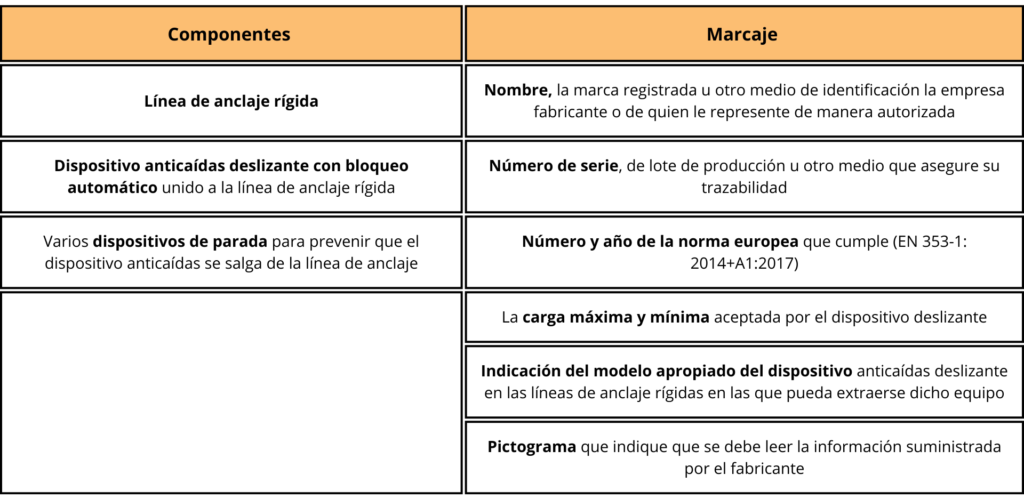
The rigid anchor line is intended to be fixed to a structure. It may consist of a rail or a tensioned wire rope with a minimum diameter of 8 millimeters.
When the guided type fall arrester can be removed from the rigid anchor line, it includes an indication of its correct orientation and of the appropriate type of rigid anchor line it can be attached to.
Requirements of the UNE EN 353-1 Standard
- Load resistance: The system must withstand a minimum static load without damage.
- Dynamic performance tests: The device must be able to arrest a fall under controlled conditions, limiting the impact force on the user to safe levels.
- Durability and corrosion resistance: The materials used must be durable and corrosion-resistant to ensure a long service life for the system.
- Ease of inspection and maintenance: The design must allow for easy inspection and maintenance to ensure the system is kept in optimal condition.
UNE EN 353-2:2002. Guided Type Fall Arresters on a Flexible Anchor Line
This part of the standard focuses on guided type fall arresters that operate on vertical flexible anchor lines. The flexible anchor line may consist of a synthetic fiber rope or a wire rope.
Parts of a Fall Arrester on a Flexible Anchor Line
A fall arrester on a flexible anchor line consists of:

Where applicable, the upper end of the anchor line is fitted with a suitable termination (for example, a spliced or knotted eye in the case of ropes, or a swaged ferrule in the case of cables) so that the line can be attached to an anchor device located on the supporting structure.
Guided type fall arresters on a flexible anchor line are marked with the following information:
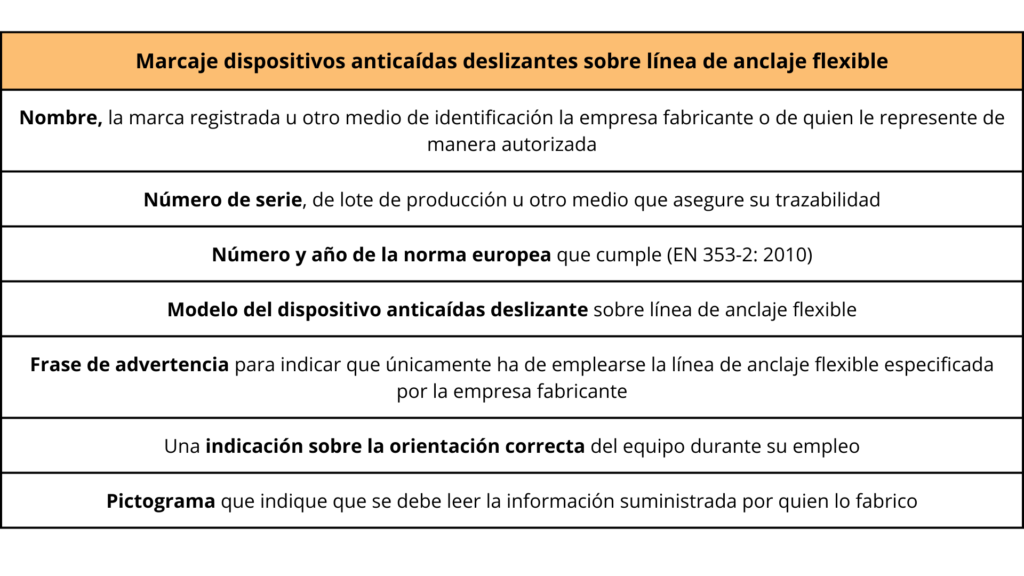
Requirements of the UNE EN 353-2 Standard
This part of the standard includes specifications on the operation and safety of the devices in environments where flexible anchor lines are used, ensuring that they meet safety and efficacy standards.
The manufacturer must provide information on, among other things, the minimum clearance below the feet of the person to work safely with the fall arrester on a flexible anchor line.
Therefore, before use at the workplace, this minimum clearance must be compared with the clearance available at the workplace where there is a risk of falling from a height. The possible pendulum swing during a fall must also be taken into account.
In upcoming posts we will discuss each part of this UNE standard in more detail. As always, we hope you found this article useful, and if you have any questions or need advice, please do not hesitate to contact us.