


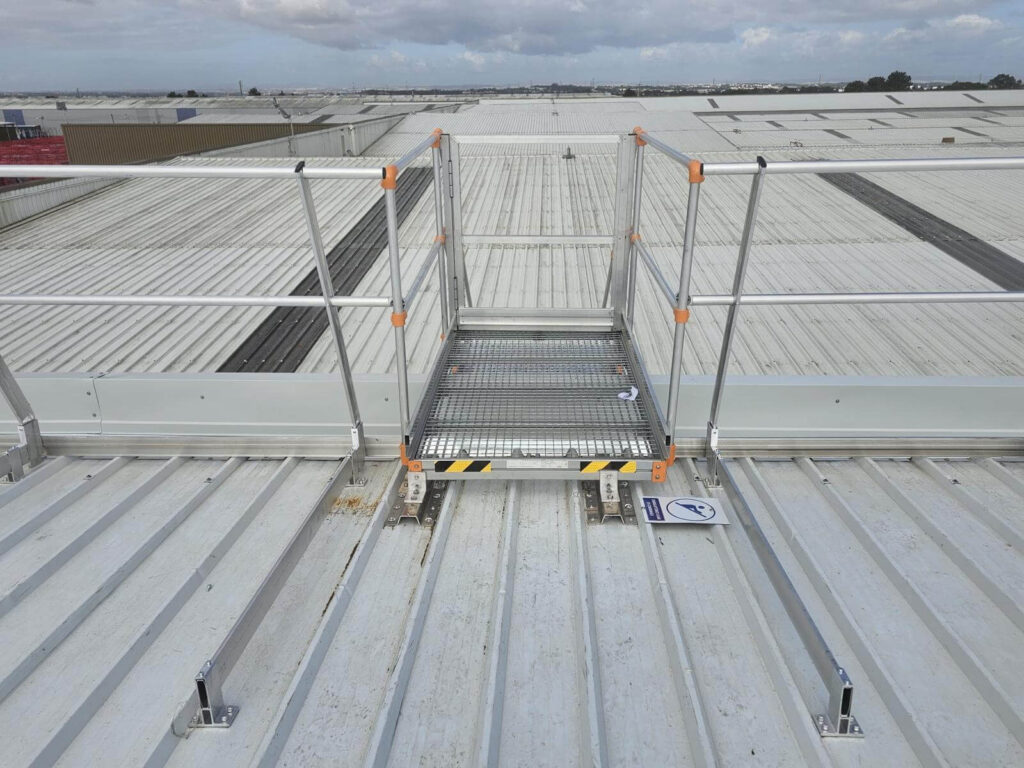
Continuing our series on standard UNE EN 14122-3, which we have covered in previous posts, today we will take a closer look at the methods the standard proposes for verifying compliance with the safety requirements for stairs and steps.
Obligations Under Standard UNE EN 14122-3
The standard makes it possible to verify the requirements we discussed in the previous post, covering the construction and materials used to manufacture stairs as well as their structure and steps, through a test that measures deflection in individual steps.
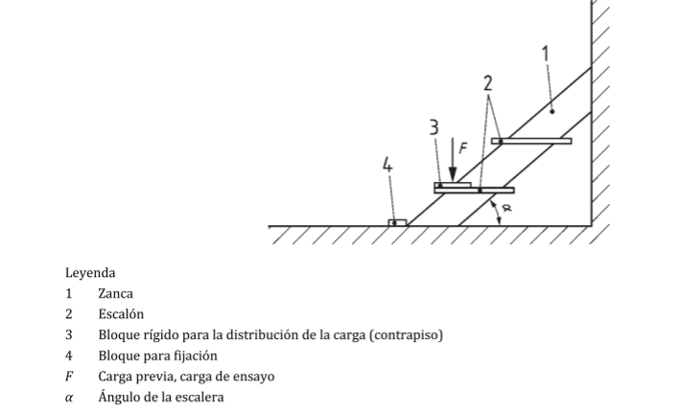
Standard UNE EN ISO 14122-3 requires that the test be performed on a section of the stair containing at least two steps.
In addition, the sample must be fixed to the floor and to the wall so that the sample structure does not move during the test (image 1).
Depending on the clear width, w, between the stringers and the supporting structure, the test is carried out with one test load (image 2) or two test loads (image 3).
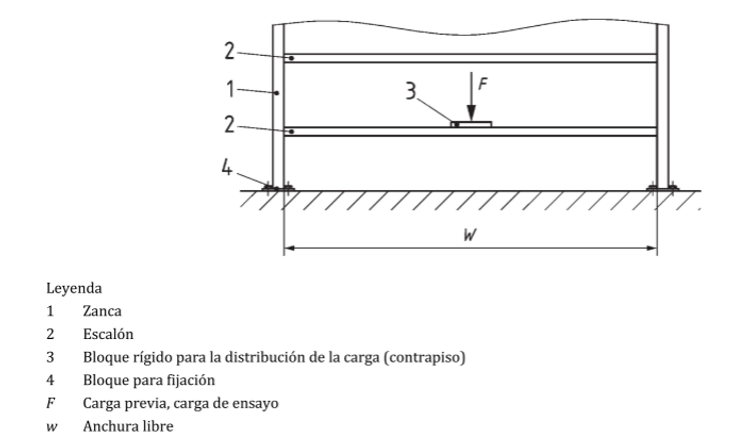
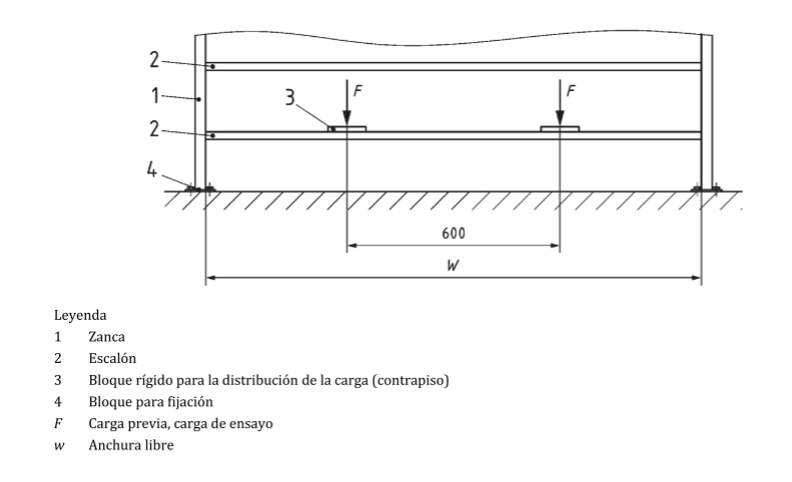
The loads must be applied to a rigid block with maximum dimensions of 100 mm x 100 mm and no sharp edges.
The test load is given by the following formula: Fs = µ x Fd
Where the minimum design load, Fd, is 1.5 kN and the material factor µ = 1.75 for steel and aluminum.
To avoid measurement errors caused by settling effects, the part of the stair being tested should first be loaded with a preload, Fp = 0.25 x Fs
Test Procedure for Standard UNE EN 14122-3
The test procedure consists of placing the 100 mm x 100 mm rigid block 600 mm away, at the most unfavorable point(s) of the step, in accordance with images 1, 2, and 3.
Next, the preload, Fp., is applied to the rigid block or blocks and held for at least one minute; after the load is removed, the displacement gauge must be reset to zero.
Then the test loads, Fs., must be applied slowly and held in position for at least one minute. After the load is removed, the permanent deflection must not exceed 0.3% of the span or 6mm.
With regard to testing the steps, standard UNE EN ISO 14122 refers us to another well-known standard, EN 131-2. Ladders. Part 2: Requirements, testing, marking.
We hope this post has explained how the test is performed to verify compliance with the requirements for stairs and steps, and that it will be useful to you in the future.