


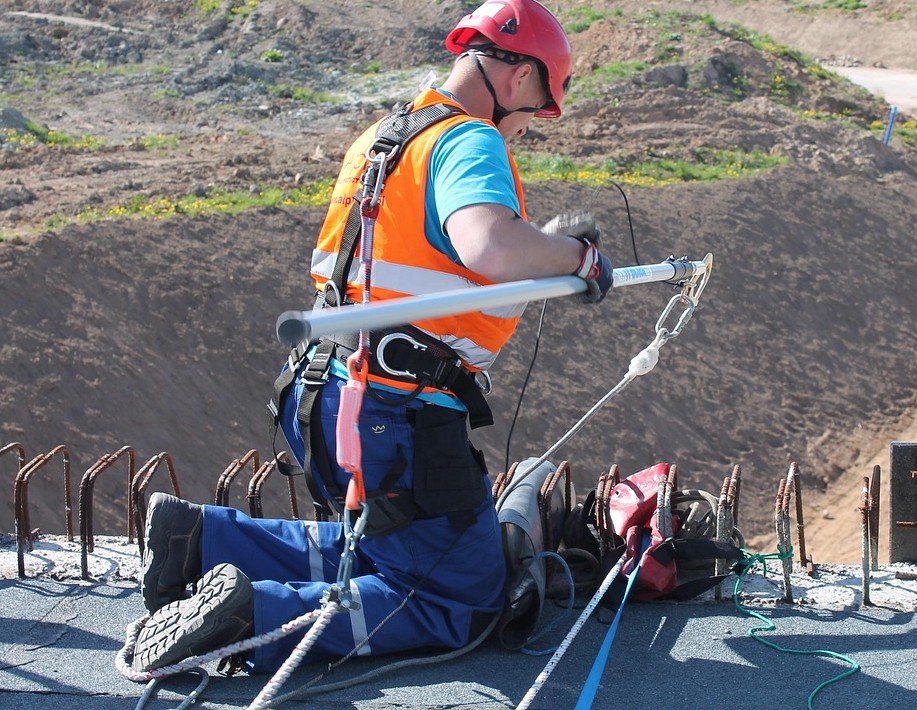
In work at height, and in fall arrest devices, one of the best-known elements is the energy absorber. But do we know what it is for? How many types are there? Are they compatible with all systems?
In this article we will answer those and other questions.
What Is an Energy Absorber?
An energy absorber is a component designed to reduce the force generated after a fall, so that when the worker falls it comes into action and reduces the force transmitted both to the worker and to the anchor structure.
This is important because it is established that the human body can withstand a maximum of 6kN without injury, which is why the energy absorber is a key element in many fall arrest systems.
Types of Energy Absorbers
An energy absorber can be found in different devices, both in PPE and in anchor systems, for example:
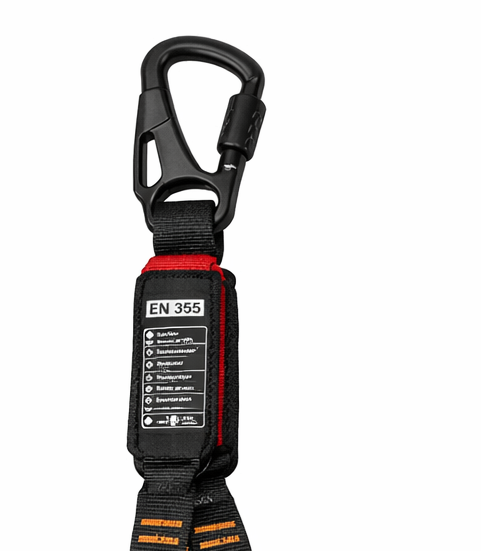
Energy Absorbers in Textile Elements
These elements are part of some PPE, especially when working at fall factor 2, and can be found in:
- Double lanyards
- Slings or single lanyards
- Self-retracting fall arresters
In these cases the energy absorber is usually a band sewn back on itself that deploys according to the force generated during the fall. It may be on the outside or the inside of the PPE, and can have different lengths that must be taken into account in calculations such as the clearance distance.
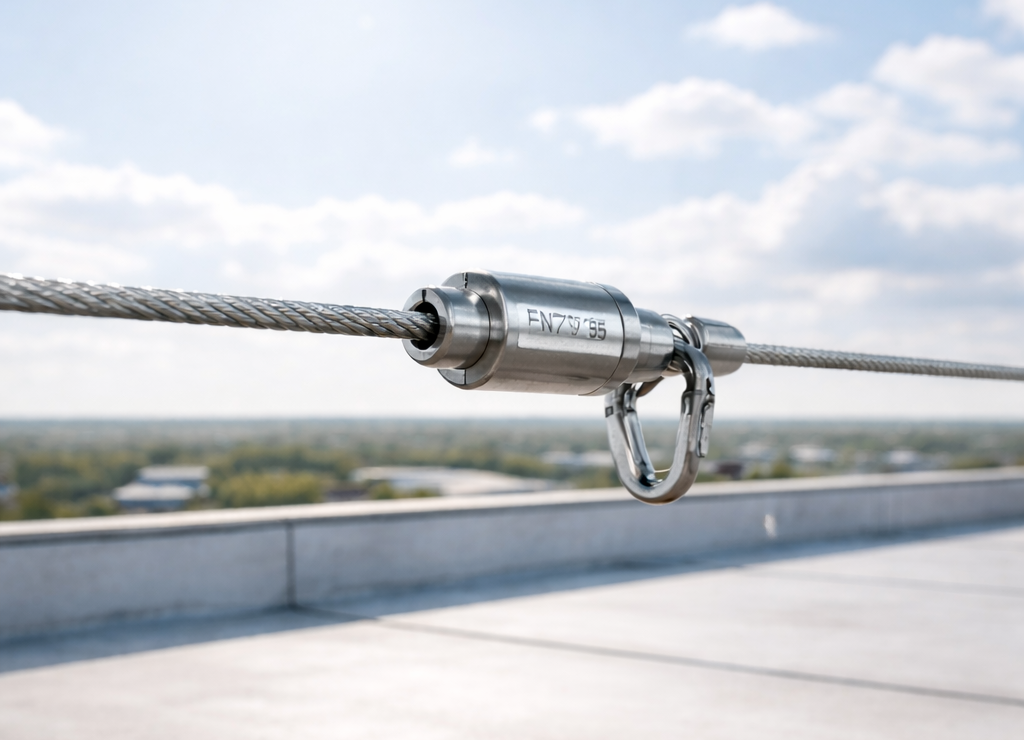
Energy Absorbers in Anchor Systems
There is another type of energy absorber that is not part of PPE but of a system; they are commonly found in lifelines.
In this case, the system is designed to absorb the force generated in the fall and protect the structure from the loads.
How Does an Energy Absorber Work?
How it works, as opposed to how it is designed, is simple: when a fall occurs, energy is generated and therefore a force. The load generated will depend on several variables, but as we mentioned, the worker should never be exposed to more than 6kN, so:
- A fall occurs
- The anchor system tensions
- The energy absorber built into the anchor deforms (for example: if it contains a spring inside, it extends)
- Part of the energy is dissipated before being transmitted to the structure
In the case of energy absorbers in PPE:
- There is a fall
- The worker falls, and the force generated activates the textile absorber
- This absorber “tears open” as it absorbs the load
Are Energy Absorbers Compatible with Each Other?
In many cases different types of energy absorbers can (and should) coexist, but that does not mean this is always the case, since, for example, having an energy absorber means that in the event of a fall the worker ends up closer to the ground (because of the elongation of the system).
Therefore, compatibility between energy absorbers will depend on:
- The type of fall arrest system installed
- The work to be done
- The available clearance distance
- The manufacturer’s specifications for each device
- The expected number of users
Let’s look at some practical examples:
Horizontal Lifeline and Double Lanyard with Absorber
If we have a horizontal lifeline with a built-in absorber and we are working at fall factor 2, we already know that our connecting element must also have an energy absorber, but that in the event of a fall we will have to add both lengths to variables such as the worker’s height, so as not to reach the ground.
So if our clearance distance is less than that sum, we will not be able to work with these elements, since we would hit the ground, and we would therefore have to rethink everything in order to work safely.
This is therefore a common configuration, and one where both energy absorbers are compatible as long as the clearance distance is taken into account.
Anchor Point and Sling with Absorber
When we have a type A anchor point, it has no energy absorber, so we may encounter different scenarios:
- Working at fall factor 0, that is, anchored above our head, our connecting element would not need to have an absorber
- Working at fall factor 2, anchored at ground level, we would need our connecting element to have an energy absorber, to dissipate the forces generated in the event of a fall.
Conclusion
A common mistake is to analyze the components of a fall arrest system separately rather than as a whole; this can cause the worker to hit the ground in the event of a fall because, for example, the extension of the energy absorber was not taken into account.
Therefore, it is only by considering the entire fall arrest system as a whole that it is possible to determine whether the user is working safely.
Energy absorbers are essential components for ensuring that, in the event of a fall, the worker suffers as little harm as possible, but although they all fulfill the role of dissipating energy, they do not have the same function within the system.
In many cases, as we have seen, energy absorbers are compatible with each other, but this compatibility will depend on the design of the fall arrest system as a whole, the clearance distance, and the manufacturer’s specifications.
The selection and configuration of protection for working at height must always be based on a technical analysis of the complete system, ensuring that all components work correctly in the event of a fall.