


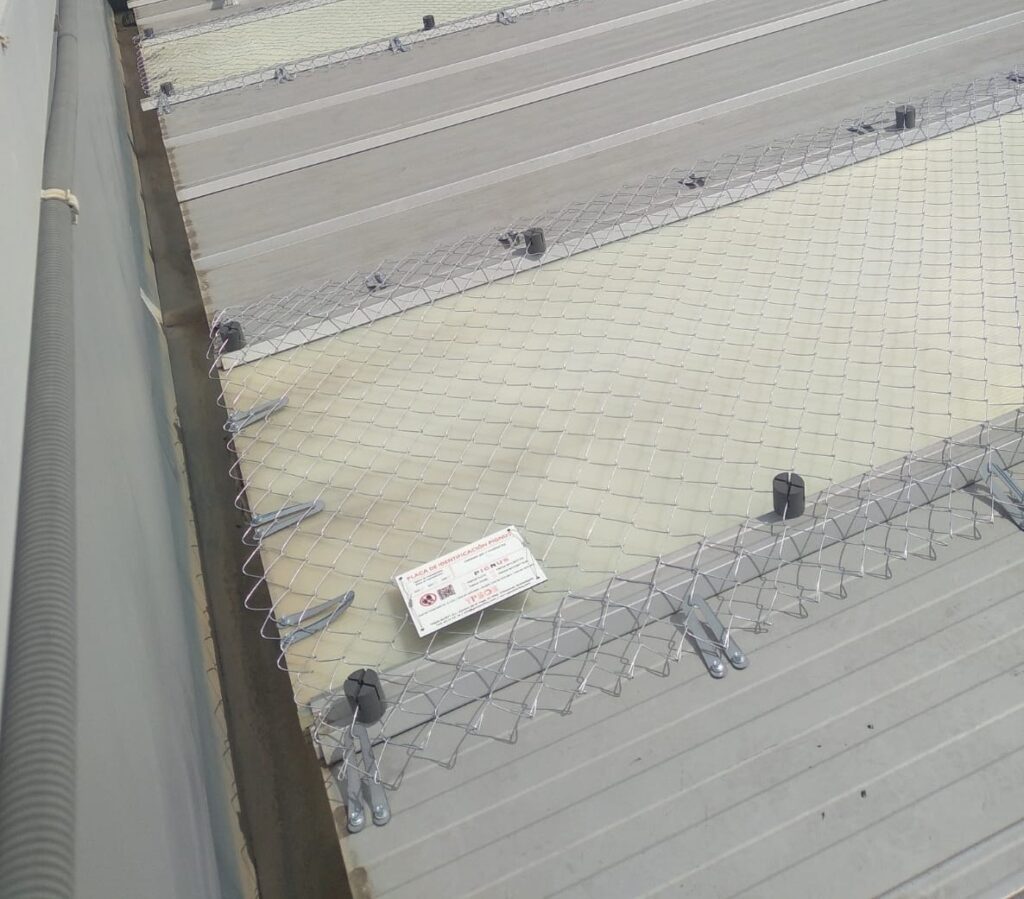
We see more and more skylights on industrial buildings and commercial properties. They are great for making use of natural light and improving comfort, but let’s be honest: they are also a significant risk for anyone who has to step onto the roof. That is why protecting them properly is not optional.
We will look at why these elements need specific protection, what a manufacturer of fall protection systems must consider when designing nets or safety walkways, and how to keep everything in perfect condition over the long term.
Why Do Skylights Need Protection?
Skylights have several weak points that make them risk areas:
- They are not designed to be walked on. You might think twice, but a distraction, a slip or a misstep can end with the skylight broken and you falling through. Literally.
- They are located in the worst places. Sloped roofs, wind, rain, ice… It all adds up to make it easier to lose your balance exactly where you shouldn’t.
- They are not always easy to see. Often they are not properly marked, or because they are exposed to the weather and to the dirt on the roofs where they are located, you can get close without realizing you are in a danger zone.
- Maintenance is complicated. When you go up on a roof to check cooling equipment or photovoltaic panels, or to clean or make repairs, you are working at height. A mistake here is very costly.
- The environment doesn’t help. If there are gases, humidity, sun exposure, corrosion… everything deteriorates, including the skylight. And an aged one is even more fragile.
What Are the Most Common Accidents?
As we have mentioned before:
- Accidentally stepping on the skylight (or the poorly protected area around it), which breaks and you fall into the building or industrial facility.
- Collapses because the material can no longer hold up or because too much weight is placed on it (remember that they are not walkable).
- Slips on the roof that send you straight into the skylight.
- Failures in the installed protections: loose fasteners, corrosion, old materials that don’t do their job when you need them most.
- Lack of maintenance, which means nobody notices that the protection no longer serves any purpose.
For all these reasons, skylights should be marked in red in any safety and maintenance plan.
What Does a Manufacturer Consider When Designing Skylight Protection?
When someone designs a net or walkway to protect skylights, they have to take several factors into account:
- Know the type of skylight. (Dome, flat, continuous…), size, slope, roof finish, and how often workers will be working in the vicinity. The UNE-EN 1873:2015 + A1:2016 standard speaks specifically to this for plastic skylights.
- Withstand loads. The protections must support the weight of people, tools, impacts… with plenty of margin. And keep in mind that over time they will deteriorate (material fatigue, corrosion).
- Fit the roof well. You can’t install a protection system that breaks the watertightness, causes leaks or damages the structure. It has to be adapted to each type of roof: metal sheet, sandwich panel, gravel, sloped…
- Durability over time. Materials must be chosen according to how aggressive the environment is: proximity to the sea, industrial gases, excessive humidity… And everything must be easy to inspect and clean.
- Make safe passage easier. If maintenance workers are going to go up continuously, you need elevated walkways, non-slip flooring, safety guardrails, lifelines, anchors… A system that lets people move around without having to step on the fragile area.
- Comply with regulations. Since these are systems found mainly at height, in addition to the regulations already mentioned, you must consider Royal Decree 2177/2004, of November 12, amending Royal Decree 1215/1997, of July 18, establishing the minimum safety and health provisions for the use of work equipment by workers, regarding temporary work at height.
- Provide all the documentation. Declaration of performance, CE marking if applicable (skylight), test reports, maintenance manual…
- Choose the best solution. Depending on the use, the roof, the environment, the budget… Each protection has to be studied individually.
Which Type of System Is Best?
It depends a lot on each case.
- For occasional access: If the roof is rarely accessed (an occasional periodic inspection), a properly sized net can be perfect. Economical and effective.
- For frequent traffic: If people go up often (maintenance, cleaning, solar panels…), an elevated walkway with or without guardrails is better. That way nobody has to step near the skylight.
- For large roofs with several skylights: The ideal is to combine: net + walkway + signage + guardrails. A comprehensive system.
What matters is that the protection is collective, working on its own without depending on the worker. And always: clear signage, clearly marked restricted areas and an inspection plan.
Which Regulations Must Be Considered?
- UNE-EN 1873:2015 + A1:2016: The current standard on plastic skylights (specifications and tests).
- There is also the UNI-EN 1873:2014 version, used in some countries as an international reference.
- Regulations for fall arrest systems, guardrails, walkways, impact testing, dynamic load, corrosion…
- Tests that prove it works: impact resistance, hardness, fatigue, corrosion, light transmission…
The manufacturer should provide the Declaration of Performance, the CE marking where applicable, and the guarantee that production control is rigorous.
Design of Safety Nets and Walkways
Which Materials Are Best?
Choosing materials is key to making the system last and work well:
- Structural material: Stainless steel (AISI 304 or AISI 316) or quality aluminum. In aggressive environments (coastal, heavy industry), AISI 316 or anodized aluminum is better.
- Surface protection: If it is ordinary steel, you need zinc plating, galvanizing or paint (polyester, thermal coating) to prevent corrosion. The UNE-EN ISO 9227 standard is used for salt spray corrosion testing.
- Non-slip finish: On walkways, gratings with non-slip treatment, well-defined steps and guardrails at the correct height.
- Fasteners that don’t compromise the roof: No water leakage, no rust… On roofs that can’t be drilled, a counterweighted guardrail is used to avoid penetrations.
- Metal nets: Galvanized or stainless, well tensioned, with small openings so tools can’t fall through. It is advisable for the net to reach a minimum resistance of 1,500 joules.
- Aesthetics and functionality: If the net is visible from inside, it should look good. If the walkway passes overhead, it should have side protection and a good finish.
How Does the Environment Affect the System?
The environment can be very harsh and you have to plan for:
- Humidity and condensation: They corrode fasteners and profiles. In coastal or very humid areas, reinforced anti-corrosion treatment is mandatory.
- Temperature: Heat, cold, direct sun (UV)… All of it causes expansion, cracks and loosening of screws. You have to design with these changes in mind.
- Industrial gases: In buildings with chemical processes (painting, galvanizing, tanning…) there may be vapors that attack the materials. A galvanized net can lose its protection in a short time.
- UV radiation: It degrades the plastics of the skylight, reducing its strength. That is why the protection must also account for aged skylights.
- Fatigue from repeated use: With a lot of traffic, fasteners loosen, the net loses tension, play appears…
- Dirt: Dust, liquids… compromise grip. The design must allow easy cleaning and inspection.
The manufacturer must specify what type of environment the system can withstand (corrosion classification C3/C4 according to ISO 12944, for example) and how long it will last.
Long-Term Maintenance
Once installed, don’t forget about the system. You must ensure it continues to do its job:
- Periodic visual inspection: Check net tension, play, loose fasteners, corrosion, deformation, dirt, cracks in the skylight…
- Load check: You can verify net tension with a dynamometer or confirm that the anchors maintain their design strength.
- Corrosion testing: In aggressive environments, salt spray or thickness-loss monitoring to estimate the remaining service life.
- Fatigue testing: For heavily used walkways, check the condition of the non-slip flooring, guardrails, deformation…
- Condition of the skylight: Although it is not part of the protection, it is advisable to check that it has not lost strength through aging.
The manufacturer should tell you when to consider the system out of service (deformation of X mm, corrosion of Y %, play of Z mm…). And all of this must be documented: dates, results, repairs, responsible parties.
What Documentation Must the Manufacturer Provide?
The manufacturer must give you, at a minimum:
- Technical data sheet of the system (materials, dimensions, loads, fasteners, installation)
- Test report (load, impact, fatigue, corrosion, expansion…)
- Declaration of performance with CE marking if applicable
- Installation and maintenance manual (assembly, tensioning, verification, cleaning, service life)
- Recommended maintenance plan (frequency, what to check, when to replace)
- Drawings and spare parts catalog (for walkways or metal structures)
- Warranty certificate (estimated service life, conditions)
- Compatibility report with the roof (that it does not break the watertightness or the insulation)
Before starting to use the system, draw up an installation record with photos, a drawing, verification of fasteners and the signature of a competent technician.
How Often Should It Be Inspected?
It depends on the use, the environment, the type of roof… But as a guideline:
- Basic visual inspection: Once a year to detect obvious problems.
- Intermediate inspection: Every 2-3 years, more thorough. In very harsh environments or with heavy traffic, every year or year and a half is better. Some experts recommend inspecting metal nets over skylights at least every 3 years, even though it is not mandatory.
- Full inspection: When you carry out a major renovation of the roof or the use of the building changes.
- Component replacement: The manufacturer must indicate the service life (10-15 years under normal conditions). When that time comes, even if it seems to have no problems, consider replacing it preventively.
All of this must be recorded in the company’s maintenance plan, with signed records, photos and a checklist of what was inspected.
Our Recommendation as Manufacturers
When you purchase a skylight protection system, demand:
- Complete technical data sheet
- Declaration of performance in accordance with the standard
- Maintenance manual
- Installation documentation (tensioning, fasteners, verification)
And in your safety plan, mark the skylight area as a special risk zone. Make sure the work method for roof access includes inspecting these systems before starting.
Conclusion
Protecting skylights with nets and walkways is not a whim or an extra. It is essential to prevent serious accidents on industrial or building roofs.
What we have covered, in summary:
- Skylights are critical risk points: accidental steps, falls, collapses. Most fatal accidents on roofs occur from falls through a skylight.
- A good manufacturer thinks of everything: dimensions, loads, compatibility, durability, environment, regulations (such as UNE-EN 1873:2015 + A1:2016)…
- The design requires suitable materials, anti-corrosion finishes, fasteners that don’t compromise the roof, and allowance for wear…
- Maintenance doesn’t end with installation: annual inspections or every few years, periodic testing, up-to-date documentation.
- From an occupational safety standpoint, the key is collective protection: the system works on its own, without depending on the operator.
If you have any questions, you can contact us.