

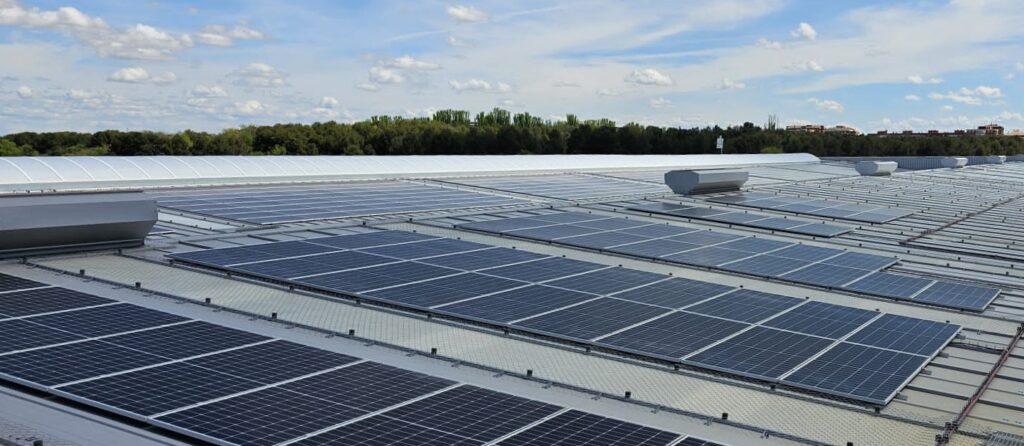
When we talk about photovoltaic energy and solar panels, we refer to energy efficiency, cost savings, and environmental benefits, but little importance is given to the safety needed when you climb onto a roof or rooftop.
In this post we will discuss the main risks, the mandatory safety elements, the differences between collective and personal protection and what to use in each case, and the regulations that apply to this sector.
Main Risks in Photovoltaic Systems
The installation and maintenance of photovoltaic systems involve a multitude of occupational hazards that need to be assessed and for which the necessary preventive measures must be taken. Among the most common are risks arising from work at height, such as falls from a roof to a different level, and electrical risks, present due to the proximity of power lines. Knowing these risks is essential to ensure the safety of the workers exposed to them.
Roof Fall Risk
Falls to a lower level are the most frequent cause of accidents in various sectors, such as the construction or maintenance of photovoltaic installations. On pitched or flat roofs, the most common fall risks are:
- Falling off the perimeter, especially on roofs without perimeter protection or a parapet.
- Slipping on wet or steeply sloped surfaces.
- Falling through skylights and fragile elements that may be located beneath the solar panels.
- Loss of balance while carrying material, with a higher risk when it is not possible to free the hands.
Electrical and Structural Risks
Safety in photovoltaic systems must take into account the specific hazards of the electrical installation:
- Electrocution and arc flash: photovoltaic panels generate direct current voltage as soon as they receive sunlight, even with the inverter disconnected. An insulation fault can also cause fires or explosions.
- Structural overload: the structural load on the building’s integrity must be assessed, since the roof must support the weight of the solar panels, mounting structures, and other external factors.
- Corrosion and wear of anchors: over time, fastening and anchor points can suffer damage that puts at risk both the photovoltaic installation and those working on the roof.
Mandatory Safety Elements in a Photovoltaic Installation
The Spanish and European regulations that set out the mandatory safety elements in a photovoltaic installation are Royal Decree 171/2004, Law 31/1995 on Occupational Health and Safety, the Low Voltage Electrotechnical Regulation (REBT), and the Technical Building Code (CTE DB-SUA).
The most relevant elements found in the regulations are:
- Collective protection
- Approved safety nets
- Perimeter guardrails
- Horizontal lifelines and anchors certified to the EN 795 standard for roofs where guardrails cannot be installed.
- Access walkways or roof walkways with a non-slip surface
- Personal Protective Equipment (PPE)
- Fall arrest harness with absorber
- Protective helmet with chin strap
- Non-slip safety footwear
- Insulating gloves for electrical work
- Protective glasses
- Electrical protection
- Electrical hazard signage
- Surge protectors
- Grounding of the metal structure per ITC-BT-26
Collective vs. Personal Protection: What to Apply in Each Case
As we already know, one of the fundamental principles of occupational health and safety is to always prioritize collective protection over personal protection. For this reason we must be clear about when to apply one or the other.
Collective protection is the first option whenever conditions allow. It is applied when:
- The roof is accessible and allows the installation of fall arrest nets for solar installations or roof safety guardrails.
- The number of workers and the duration of the work justify the investment in collective protection.
- There are skylights or openings that must be covered for safety.
On the other hand, Personal Protective Equipment (PPE) can be used as a complement to collective protection or on its own in cases such as:
- The roof is too steep or fragile and cannot support the installation of other systems, in which case the lifeline for photovoltaic roofs is the most effective solution.
- The work to be done is temporary and lower risk.
- Collective protection does not cover the entire work area.
How to Ensure Safe Roof Access
One of the highest-risk moments in the installation or maintenance of solar systems is access to the roof, for which we have to take certain aspects into account:
- Prior roof assessment: it is important to review its current condition, the structure and strength of the materials, the slope, and the presence of fragile elements.
- Proper access: by means of approved ladders, either with a fall arrest device or with a safety cage.
- Certified anchor systems: these systems make installation and periodic maintenance work easier, reducing the time workers are exposed to risk.
- Signage and marking of the work area and restricted access for authorized personnel.
- Training and coordination: all personnel accessing the roof must have received prior specific training in work at height and on the risks involved in photovoltaic system safety. Business activity coordination (CAE) is mandatory when more than one company is involved on the same site.
Does Your Photovoltaic Installation Comply With Regulations?
It is essential to verify that the photovoltaic installation complies with current regulations and safety protocols. The aspects that an OHS technician or the person authorized to handle safety coordination must verify are:
- Have a Safety and Health Plan approved by the safety coordinator at the design stage.
- Meet the standards and certification of the collective protection means in accordance with EN standards.
- Periodically inspect PPE: expiration, condition of the energy absorber, etc.
- Verify that the electrical installation is legal with the competent body of the autonomous community, with the electrical installation certificate (CIE) signed by the installer.
- Periodic visual and thermographic inspection of the modules and connections to detect hot spots or deteriorated insulation.
Frequently Asked Questions About Safety in Photovoltaic Installations
In a photovoltaic installation, collective protection is mandatory when there is a risk of falling to a lower level (safety guardrails, nets, or roof walkways), along with signage and the appropriate PPE for the task to be performed: fall arrest harness, helmet, non-slip footwear, and insulating gloves for electrical work.
When installing solar panels, the following precautions must be taken into account: assess the condition and strength of the roof; install collective protection systems before starting work; use a safety harness connected to the anchor points; keep electrical risks in mind; ensure the training of the workers who will climb onto the roof and comply with the Safety and Health Plan.