


In several of our posts we have talked about the importance of safety at height. Article 15 of the Occupational Health and Safety Law 31/1995 tells us that measures protecting collective safety must take precedence over those protecting individuals.
For this reason, safety guardrails, also known as edge protection guardrails, fully comply with this regulation by offering collective protection to users.
Even so, an inadequate risk assessment or a poor choice of system type can lead us into unnecessary dangers.
Therefore, today we will talk about how to carry out a proper risk assessment and, with it, decide in which situations to install these guardrails.
Risk Assessment in Work Environments
Commonly, when we think of safety guardrails, the first thing that comes to mind is protecting the perimeter of industrial roofs.
Beyond that, these safety elements, as the UNE EN ISO 14122 standard indicates, serve both to protect against the risk of falling from height in industrial areas and to protect access to machinery, including stairs, work platforms, walkways, etc.
For safety guardrails to perform their function properly, we must carry out a risk assessment of the work area before installation in order to determine which system best fits the specific situation we face.
This helps us avoid unnecessary risks that could result from an incorrect choice made because no such assessment was carried out.
What Are the Steps of a Proper Risk Assessment?
To identify the type of risk, we take the following steps:
- Visual inspection: This helps us identify the areas where there may be risks for operators.
- Task analysis: We review all the tasks performed in the area to be protected to find out whether there is actually a risk of accident based on the tasks carried out there.
- Accident history: We check whether there are records of previous accidents that can give us a risk pattern.
- Consulting operators: Workers, who are exposed to risk every day in their various tasks, can provide very valuable information when deciding on the type of system to implement.
Once we identify the risks, we assess their likelihood and severity scale based on whether they would cause minor or very serious harm.
With all these values, we obtain the risk score, which in turn tells us whether we need to install safety systems to protect against those risks, such as perimeter protection guardrails.
When Will We Need Safety Guardrails?
As we noted above, guardrails are considered a collective protection measure, which makes them a safety element widely used in industry.
There are also a number of circumstances that lead us to choose these safety systems, because if the following situations arise, their use is mandatory under the guidelines of the UNE EN ISO 14122 standard. These cases are:
- Platforms or walkways more than 500 mm high.
- Fixed ladders with height differences greater than 1 m.
- Openings or gaps through which a person could fall.
- Work areas with a risk of falling from the sides.
In all of these cases, we will opt to install safety guardrails, since their use is mandatory.
Which Guardrail Should Be Installed in Each Situation?
Once the system has been decided, remember that we must choose the most suitable model according to the installation surface, bearing in mind that we have the following models available:
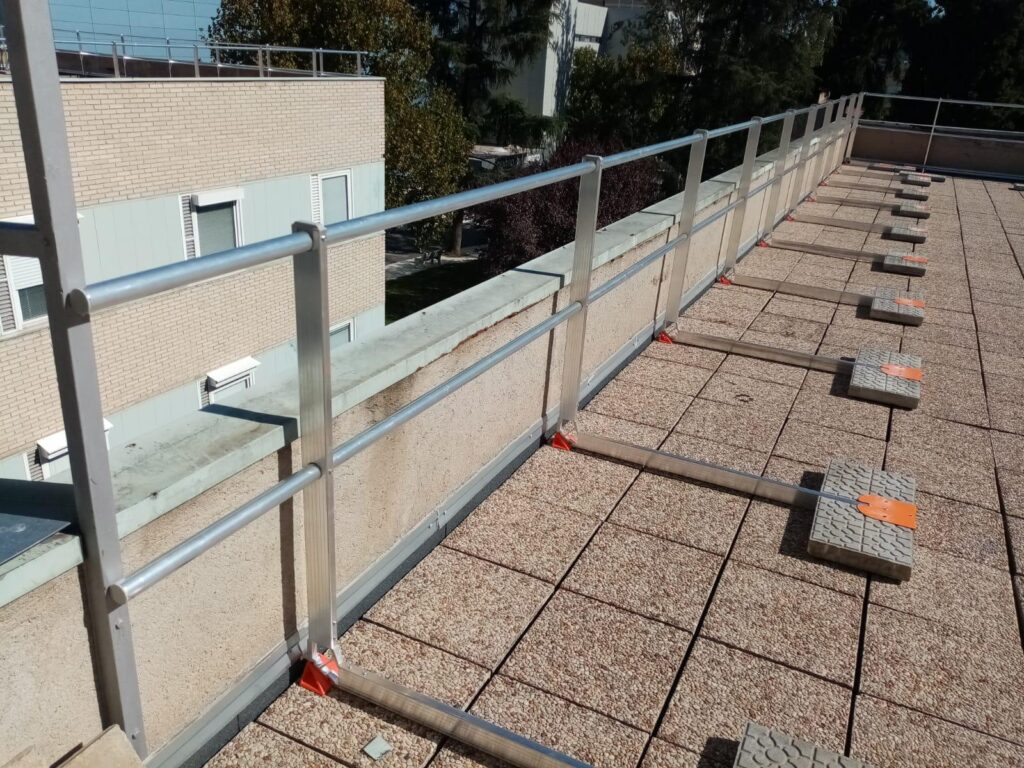
- Counterweighted guardrail: When fixing to the roof or installation area cannot be done using anchoring elements.
- Guardrail fixed to sheet metal or sandwich panel.
- Guardrail fixed to a wall or side.
- Guardrail fixed to the floor.
Let us also remember that, depending on the installation environment, we must choose one manufacturing material or another. Installing a safety guardrail in a dry climate is not the same as installing one in a salt-laden environment; its materials or finishes must be modified to ensure its elements will not rust or deteriorate prematurely, in order to avoid risks.
Conclusion
As we can see, when deciding to install protective guardrails, it is just as important to collect data beforehand and thoroughly assess the possible risks as it is to choose the right model and material for each specific need our customers may have.
What is common to all installations is that these safety systems provide collective protection, complying with OHS regulations while creating safer work environments.
As we always recommend, at Ypsos Safety we stress that all of these assessment, installation, and maintenance tasks should be carried out by properly qualified personnel, since otherwise we could incur risks through a poor decision. This way, we ensure a safer, accident-free environment.