



Today we will continue talking about the duties of the OHS technician in work at height, specifically their role with respect to work at height.
If there is one area that occupational health and safety technicians are especially concerned about in their work, it is the danger that work at height. poses to operators.
What Is Work at Height?
In general, “work at height” means work performed in a place above a reference level, understood as the surface onto which the worker could fall and suffer personal injury.
Work involving a risk of falling from a height of more than 2 meters requires the use of fall protection. This height is measured from the surface on which the person is located to the lower level on which they would land if no means of protection were available.
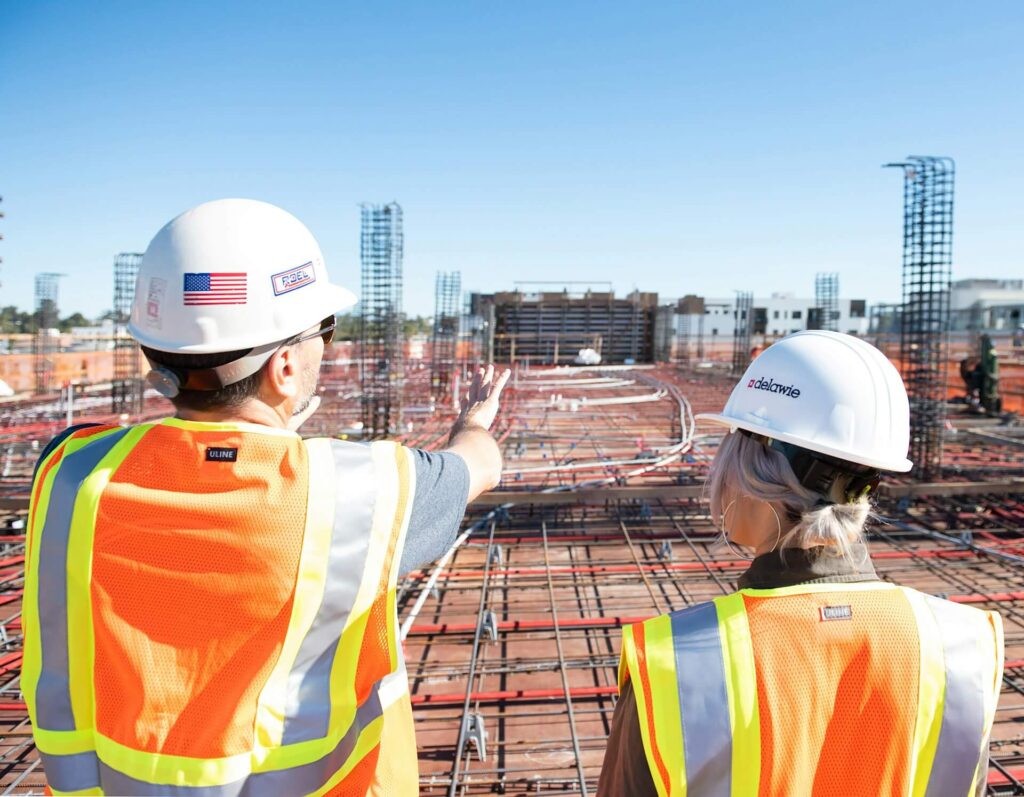
However, in addition to the fall height difference, there may be an additional danger due to the nature of the place where the fall could occur, such as the presence of exposed rebar, a machinery passage area, or even a fall into the sea.
Therefore, it is the risk assessment that will determine the need, if any, to adopt prevention or protection measures against the risk of falling from heights of less than 2 meters.
The following phases must be observed before work at height:
- Identify the fall risk
- Risk control:
- Eliminate the fall risk whenever possible by avoiding work at height.
- When the risk cannot be eliminated, the measures taken must aim to reduce the fall risk by adopting collective protection measures.
Carrying out this work under appropriate safety conditions includes both the use of safe work equipment and specific theoretical and practical information and training for workers.
If it is not possible to meet the two preceding requirements, the company is obligated, as established in Article 3 of the aforementioned Royal Decree 1215/1997, to choose work equipment that is suitable and adapted to the task, and everything that entails, such as:
- Regulatory compliance
- Taking measures to avoid or reduce risks
- Maintenance
- The obligations established in Article 5 regarding training, qualification, and information for personnel.
Temporary Work at Height
In fact, the definition of “temporary work at height” in the Technical Guide for the assessment and prevention of risks relating to the use of work equipment, based on Royal Decree 1215/1997 of July 18 establishing the minimum safety and health provisions for the use of work equipment by workers (amended by Royal Decree 2177/2004 of November 12); does not include the 2-meter height limit.
In the particular case of temporary work at height, the provisions of Section 4 of Annex II of Royal Decree 1215/1997 will apply. That is, the most appropriate work equipment will be chosen to ensure and maintain safe working conditions.
Bearing in mind, in particular, that priority must be given to collective protection measures over personal protection measures. The choice may not be subordinated to economic criteria.
Workplace Accidents Caused by Falls from Height
Every year, workplace accidents caused by falls from height account for, statistically speaking, more than worrying figures:
“One in nine fatal accidents in the workplace is the result of a fall from height.”
According to the Ministry of Labor’s “Workplace Accident Statistics (EAT),” in 2022 there were a total of 73 fatal falls from height.
If we analyze the data in depth, there was almost one fatal accident every day during 2022, for a total of 679 tragedies in the workplace.
However, in the case of falls from height with fatal consequences, the figure is especially striking:
“One fatal accident every five days due to this type of accident.”
In terms of total accidents related to falls from height, 2022 saw 26,115 incidents, equivalent to an average of more than 71 falls from height per day.
The situation becomes more worrying when we look at serious accidents related to falls from height. According to EAT data, a total of 775 serious incidents were recorded in 2022.
The figure of 775 yields an average of more than two such accidents every day, an alarming trend. This underscores the importance of addressing safety in work at height as a priority and the need for effective preventive measures.
What has been described in the preceding paragraphs unfortunately justifies the concern of every occupational health and safety professional regarding work at height.
Duties of an OHS Technician for Work at Height
In particular, when carrying out the risk assessment and choosing work equipment for work at height, the OHS technician for work at height will take into account:
- Type of work to be performed
- Execution phases and tasks to be carried out in each one, including assembly and disassembly of the work equipment itself
- Ergonomic conditions and difficulty of the tasks, taking into account the postures, movements, and effort required to perform them
- Materials, tools, and other means needed to perform the tasks;
- Duration of the tasks
- Height and location of the workstation
- Number of people expected to perform the tasks
- Conditions of the place where the work equipment is to be located
- Weather and environmental conditions
- collective protection measures or personal protective equipment if the existing risks cannot be avoided or sufficiently limited by other means
- Additional protection measures, for example, signage and demarcation.
In upcoming posts we will continue talking about the duties of the OHS technician in work at height, specifically the importance of occupational risk assessment and the tasks of advising on and implementing a preventive culture in companies.
We hope this article has been useful in understanding the importance that work at height has for prevention technicians and how they should act.
If you need more information on ladders, types, applications, etc., do not hesitate to contact us.