


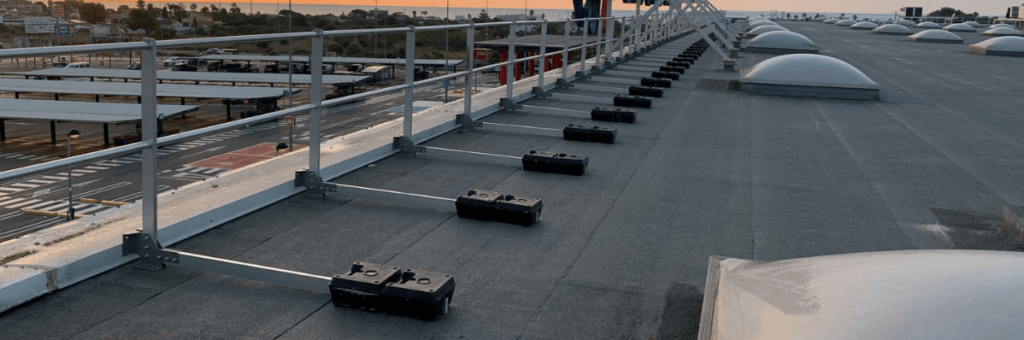
In this week’s post we are going to focus on counterweighted collective protection guardrails, explaining their features and looking at their uses, with an emphasis on our Ananke Weight guardrails.
WHY CHOOSE COUNTERWEIGHTED GUARDRAILS?
As we have seen on previous occasions, not every system is suitable for every situation that we need to protect against fall risks.
This is why different versions of safety systems are needed, so they can be adapted to the specific situations we encounter on each type of roof.
The way these and other safety devices are fixed will vary depending on the materials used to build the roofs, whether the roofs are waterproofed, or even whether waterproofing was applied afterward.
Let us consider the case of a concrete roof. Our client needs to protect the edges of the roof against the risk of falling, so, based on the occupational health and safety law, which as we have seen establishes that collective protection takes priority over personal protection, they opt for our edge protection guardrails, Ananke.
When to Use a Counterweighted Guardrail?
At first, considering the material the roof is made of, we would find no obstacle to installing a guardrail fixed to the floor with the corresponding fasteners, but the client informs us that the roof has recently been waterproofed and that no type of anchor can be fixed to it.
In these cases we have to turn to counterweighted systems. Specifically, focusing on collective protection guardrails, we will opt for our Ananke Weight model, which does not need fasteners for its installation because it has counterweights that allow the system to comply with the safety regulations established for this type of device.
But these systems are not only required when it is impossible to fix anything to the roof or area that needs protection; we also encounter situations that require that protection only occasionally.
Thanks to counterweighted systems, we can remove these elements once they have served their purpose, such as in cases of maintenance, inspections, and so on.

FEATURES OF COUNTERWEIGHTED GUARDRAILS
As for the remaining components, counterweighted guardrails contain the same elements as the other versions (floor-mounted, sheet metal floor-mounted, parapet-mounted, wall-mounted, etc.).
- Round tubes for the handrail
- Round tubes for the intermediate protection rail
- Aluminum profiles for the vertical and horizontal posts
- Mounting bases
- Caps, covers, and plastic elements
The horizontal post that forms the structure receives the weight of the counterweights to stabilize the system, and we attach the counterweight to it with the appropriate hardware.
Alongside this structure, and to allow its vertical and horizontal posts to be joined, we have another very important element: the mounting bases. They take the load that these safety systems may be subjected to at a given moment.
The remaining elements in these systems are caps, covers, and plastic elements that make installation easy and mark the necessary routes thanks to their swivel joints, which mark the turns we need to make. Besides their aesthetic and turning functions, these elements also protect users from possible cuts by covering any sharp edge of the profiles mentioned.
INSTALLING A COUNTERWEIGHTED GUARDRAIL
When it comes to safety, nothing is left to chance: the Ananke Weight counterweighted guardrails are tested under the UNE-EN 14122-3 standard. This standard and other reference standards set out all the safety guidelines that systems must meet, as well as the arrangement of the different elements and the number of counterweights that must be placed for the system to provide the necessary safety, including the weight required by the standard for these counterweights.
Our guardrails have two 12.5 kg counterweights, placed on each horizontal post found in the installation. This number of counterweights increases to three units at the ends, as indicated in our data sheets and manuals.
Another very important aspect to keep in mind when installing our guardrails is the distance between posts, which must never exceed 1500 mm.
In these tests we verify that, in the event of an accidental impact against the guardrails, they have the necessary strength to avoid breaking the system, the user falling, or these protection systems tipping over.
In conclusion, counterweighted guardrails are a good system to turn to for a variety of needs.