


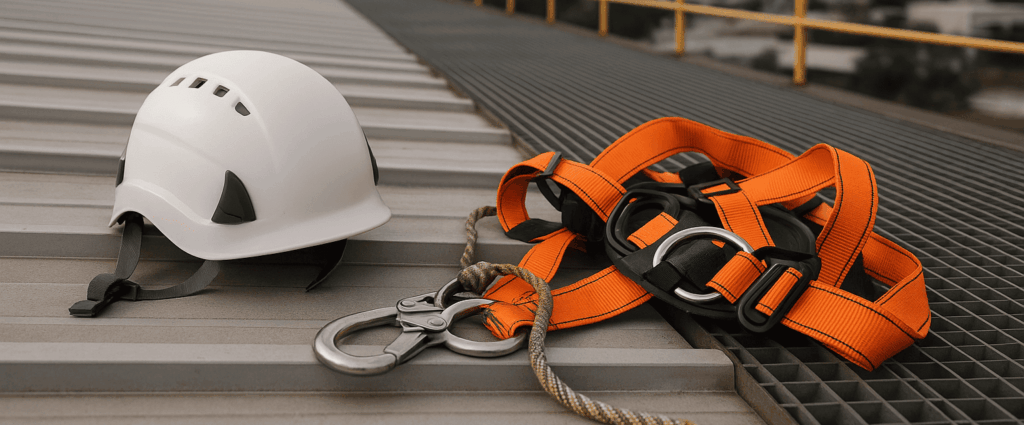
Working at height involves significant risks that must be treated responsibly. Falls from height remain one of the leading causes of serious and fatal accidents in the workplace. That is why, in addition to having effective action protocols, it is necessary to comply with occupational health and safety regulations. In this article we will explain what to do in the event of an accident at height, with direct reference to the applicable articles of Spanish legislation, and we will finish with a couple of practical cases.
What Are the Immediate Steps to Take After an Accident at Height?
Most Common Risks
Work at height is work performed more than 2 meters above the ground, and includes activities on roofs, scaffolding, ladders, platforms, or elevated structures. This work presents risks such as:
- Falls to a lower level.
- Collapse of surfaces.
- Absence or failure of fall arrest devices.
Immediate Steps
Activate the emergency plan
When an accident occurs, the first step is to activate the emergency and evacuation plan, which must be included in the company’s prevention management system or, in the case of a construction site, in the Health and Safety Plan for the workplace.
Applicable regulations:
- LPRL, Art. 20: Employers are obligated to analyze potential emergencies and adopt the necessary measures, including first aid, firefighting, and evacuation.
- RD 1627/1997, Art. 7: The health and safety plan must include procedures for responding to emergencies.
Assess the area before intervening
Before approaching the injured worker, you must check that the area is safe to avoid additional harm to rescuers or coworkers.
Applicable regulations:
- LPRL, Art. 14.2: The employer must ensure that working conditions do not pose a risk.
- RD 1215/1997, Art. 3.2: Obligation to verify that work equipment (such as structures and scaffolding) does not endanger workers.
Immobilization and primary care
Only trained personnel should take part in caring for the injured person. Basic first aid techniques should be applied, and the person should not be moved unless necessary.
Applicable regulations:
- LPRL, Art. 19: First aid training as part of the worker’s mandatory training.
- RD 39/1997 (Prevention Services Regulations), Art. 37.3: Establishes the need to designate workers to handle emergencies.
What Emergency Protocols Should a Company Have?
Rescuing the worker must be carried out with suitable systems and trained personnel. Every activity at height must provide for a specific rescue plan.
Applicable regulations:
- RD 773/1997, on the use of PPE:
- Art. 3: Mandatory use of fall arrest equipment with clear instructions for use.
- Annex II: Equipment must account for rescue situations.
- UNE-EN 363 and UNE-EN 365: Technical standards that require fall arrest systems to include recovery or rescue procedures.
Practices for Preventing Risks in Work at Height
Risk assessment
Before any task at height, a specific risk assessment is mandatory, documented and kept up to date.
Applicable regulations:
- LPRL, Art. 16.1: The employer must carry out a specific risk assessment for each job position.
- RD 1627/1997, Art. 4: The assessment must take into account the specific conditions of the workplace and the means of access.
Staff training
Specific training for work at height is mandatory and must be updated periodically.
Applicable regulations:
- LPRL, Art. 19: The employer must ensure that each worker receives adequate training on the risks of the job and on emergency measures.
- RD 39/1997, Art. 4.2: Specific training for work involving special risks, such as work at height.
Use of suitable equipment
The use of approved Personal Protective Equipment (PPE) in good condition is mandatory. This includes harnesses, lifelines, and anchor systems.
Applicable regulations:
- RD 773/1997, Art. 2 and Annex I: Requires PPE to be suitable, approved, and inspected periodically.
- RD 1215/1997, Annex II: Requires that platforms, ladders, and other equipment used be designed to prevent falls.
Supervision and control
Supervision is key to ensuring compliance with prevention measures.
Applicable regulations:
- LPRL, Art. 33: Obligation to consult workers and allow them to participate in preventive activities.
RD 1627/1997, Art. 11: The construction site safety coordinator must monitor that companies comply with the health and safety plan.
What Does a PAS Protocol Look Like After a Fall from Height?
In this section we will present two methods or options for carrying out a rescue at height in the event of an accident while work is being performed.
Direct vertical method
This is the fastest method to carry out, since the steps to follow are less involved than in other techniques.
- We will assess the severity of the worker’s condition (injuries, whether conscious or unconscious).
- We will approach the worker using the techniques we have at hand or those we consider most suitable for then continuing with the rescue. It is always advisable to have a rope line rigged for faster evacuation.
- Using our lanyards, we will connect ourselves to the injured person, placing the lanyards on the harness rings we consider most appropriate for the comfort of both the injured person and ourselves, and to avoid worsening any injuries they may have. It is sometimes advisable to place one lanyard on the back ring and another on the front center ring, so that the person can be lowered vertically, thus avoiding the feet colliding with structures.
- Once connected, we make sure the lanyards are taut enough that we can feel the injured person’s weight.
- Next, we will disconnect the injured person and, if necessary, cut the elements they are attached to (rope, lanyards, straps, etc.) so that their weight is transferred to our harness and descent system.
- We will lower the injured person to the base of the work area, always with the utmost care and attention.
Indirect vertical method
- We check the condition of the injured person, how they are doing, their injuries and the state of those injuries, and, if necessary, apply first aid knowledge.
- We will approach the injured person using the appropriate method.
- We will set up the rescue ropes with the double anchor system. It can be accompanied from the start by a hoist system if it is necessary to lift the injured person to free them from their safety system (if they are hanging in midair).
- We will attach the injured person to the harness safety rings. Check that the ropes reach the ground.
- We will position the injured person vertically and disconnect them from the safety system they are attached to.
- We will lower them to the base of the work area with care and, if necessary, with the help of a third operator on the ground and an auxiliary rope that will keep them away from the structure.
Practical Example of a Real-Life Response
Scenario: fall from a roof
A maintenance worker is repairing a fiber cement roof 6 meters high. The area has not been assessed as non-walkable, and the worker, despite wearing a harness, is not connected to an anchor point. He steps on a deteriorated sheet and falls into the building.
Protocol applied
- Activation of the emergency plan in accordance with Art. 20 LPRL.
- Assessment of the surroundings to avoid new risks (in accordance with Art. 14 LPRL).
- Primary care by a trained coworker (per Art. 19 LPRL).
- Vertical rescue through intervention by firefighters and use of a stretcher with harness, in accordance with the requirements of RD 773/1997.
- Accident investigation and report to the Labor Inspectorate in accordance with Art. 16.3 LPRL.
Root cause analysis
- The fragility of the roof was not identified in the risk assessment (Art. 16 LPRL).
- No collective protection system (such as walkways or nets) was established (Art. 15 LPRL).
- Correct use of PPE was not supervised (Art. 33 and Art. 19 LPRL).
Conclusion
Responding as quickly as possible and following the established protocol makes a great difference in the severity of an accident at height. However, the key is prevention, complying with regulations, and maintaining ongoing training. Spanish OHS legislation provides a solid framework for ensuring complete safety, but its effectiveness depends on its application in practice and on the commitment of everyone involved in this type of work, including workers, employers, and prevention services.
We hope this post has given you a general idea of the actions to take in the event of an accident at height. In any case, we are at your disposal for any questions.