


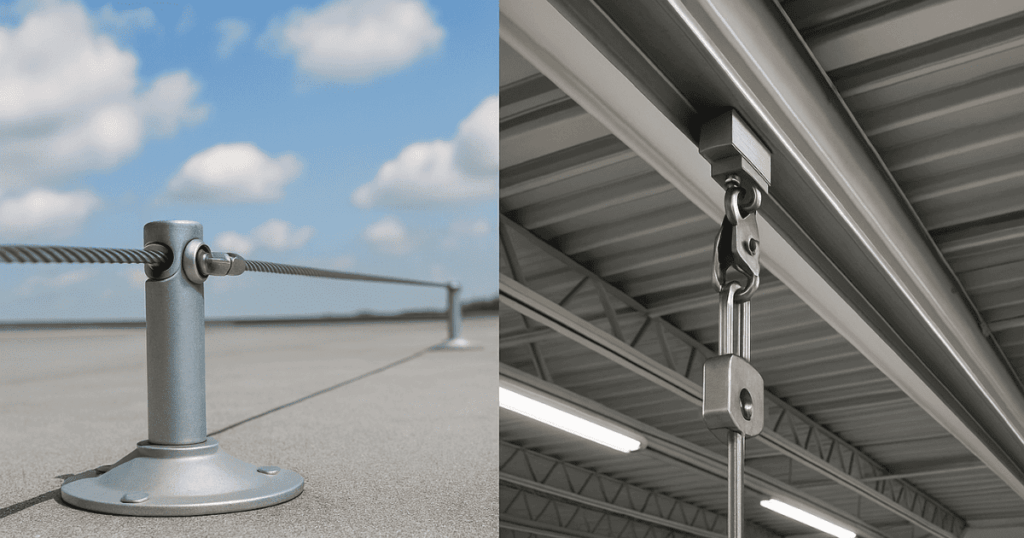
We know that every job at height has its own risks and challenges, which is why selecting the right fall arrest system is crucial for working safely.
In this post we are going to talk about one of the most common questions that can arise: flexible lifeline or rigid lifeline?
What Is the Difference Between a Flexible and a Rigid Lifeline?
To begin with, the first thing we need to know is what a flexible lifeline is and what we mean by a rigid lifeline.
Although both systems are governed by the same UNE EN 795 standard, each one corresponds to a different part of that standard:
Flexible lifelines are governed by the EN 795C standard and are those made up of a cable or a rope. In the case of permanent horizontal ones, these are usually stainless steel cable. They consist of that cable, an energy absorber, a tensioner, and anchor plates attached to the surfaces where they are installed.

In the case of rigid lifelines, these are made up of a metal rail, which gives them their rigid character. For the user to move along it, a trolley or slider is used that runs along the line itself. They are governed by the EN 795D standard.

The main difference between the two lies in how they respond to a fall: the clearance distance, the deflection of the system, and the energy absorption.
Flexible Lifelines vs. Rigid Lifelines: Advantages and Disadvantages
Both solutions ensure safety in work at height, provided that a prior study and risk assessment has been carried out and they have been installed by qualified professionals, but the two options are not equally suited to every situation.

Below, we explain the advantages and disadvantages of each system:
Flexible Lifelines
Advantages of EN 795C lifelines
- Greater versatility
- Adaptation to existing structures
- Complex routes
- Greater energy absorption in the event of a fall
Disadvantages of EN 795C lines
- Deflection or sag after a fall
- Greater clearance distance
Rigid Lifelines
Advantages of EN 795D lifelines
- Robust
- Shorter clearance distance
- Almost no deflection or sag after a fall
- Built-in trolley or slider
Disadvantages of EN 795D lifelines
- Less adaptability
- Not suitable for all structures
In short, the choice between one system or the other will depend on factors such as the layout of the environment, the intended use, the available clearance height, and the conditions of the work to be performed.
On What Types of Surfaces or Jobs Are Flexible Lifelines Recommended? And Rigid Ones?
We will choose one or the other depending on the project or the work to be done at height, since we must take into account the factors mentioned above: route, fall clearance distance, fall factor, …
Flexible lifelines are ideal for work on roofs, light metal structures, or places with long routes.
For example, we would install a cable lifeline on a solar panel roof where operators must climb up for maintenance.
Rigid lifelines are ideal in areas with low fall clearance, confined spaces, or industrial interiors.
For example, if we have to clean or maintain a tanker truck from a walkway, we will do so with a rail lifeline, since there is less fall distance and this ensures the safety of the operators.
Conclusion
There is no single solution: the choice between a flexible or rigid lifeline must be based on a technical analysis of the work environment, the available height, the frequency of use, and the associated risks. At Ypsos Safety, we support and advise you throughout the entire process. Our goal is simple: to ensure safety at height without compromising operational efficiency.