


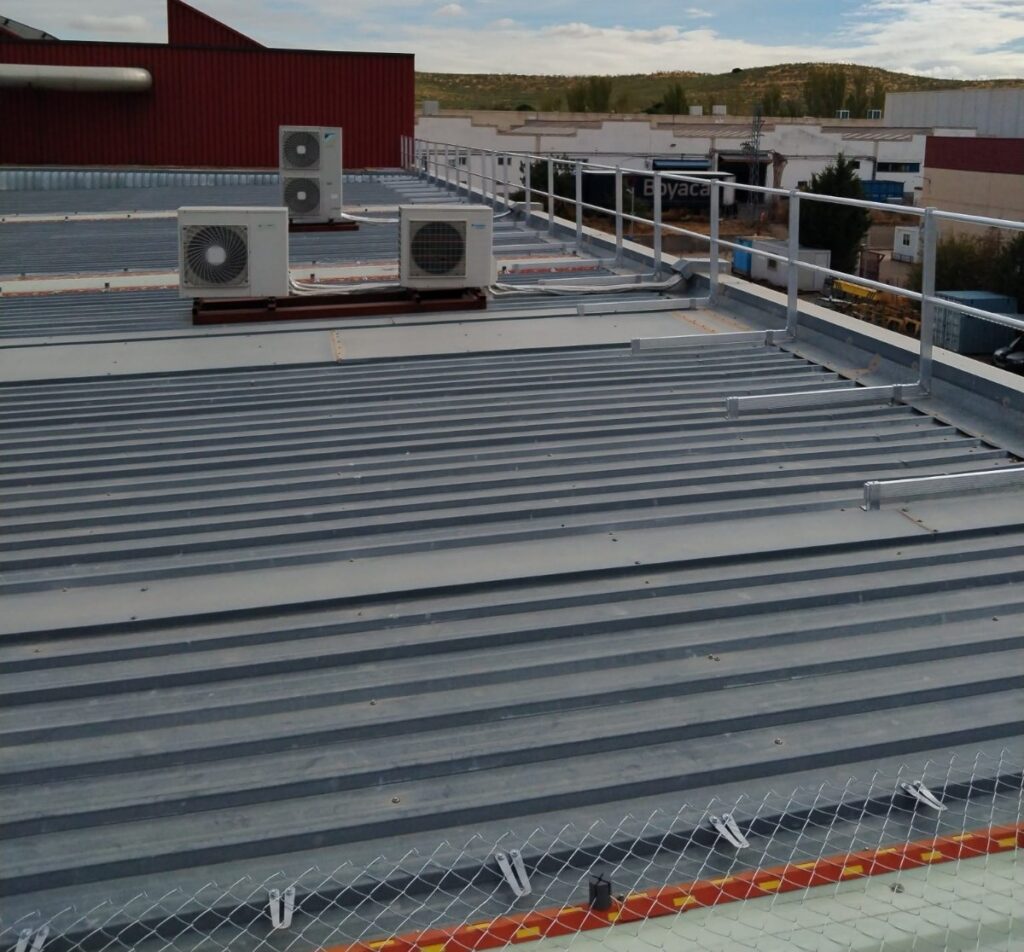
Working on roofs involves, in most cases, a clear risk of falling to a lower level. Whether for maintenance tasks, periodic inspections, technical installations or one-off interventions, a roof environment is generally not designed for continuous foot traffic without safety measures.
In addition, not all roofs are used the same way: some roofs are accessed once a year and others are walked on every day. Some allow permanent solutions and others have technical limitations that make it impossible to install them. In this context, a common question arises among those who must define the fall prevention measures for work at height: is it better to opt for collective protection or personal protection?
The answer depends on several factors, is not one-size-fits-all, and certainly does not depend on anyone’s personal opinion or preference. On roofs, the choice of protection system must always be based on the risk, the use and the specific work context.
Differences Between Collective and Personal Protection
Collective protection on roofs should be prioritized in a work environment, since it aims to prevent the fall of the whole group. These are non-individual solutions that do not require the user to take any specific action, such as safety guardrails, safety nets, etc.
Unlike collective protection, personal protection depends on the user using it correctly, such as lifelines, anchor points or connection systems. For it to work properly, the person must put on the equipment, connect and use it for as long as needed.
The difference is very clear: collective protection protects everyone who accesses the roof, whether or not they are familiar with the system, whereas personal protection protects only the person who knowingly uses it.
Why Is Collective Protection the Priority Whenever Possible?
In occupational health and safety, collective protection is prioritized because it eliminates or reduces the risk at its source, and this is specified in the OHS Law.
Therefore, on roofs in regular use, collective protection must be provided to avoid the hazard as much as possible.
A well-designed fall protection guardrail or edge protection does not require the user to think about clipping in, check a piece of equipment or remember a procedure. Safety is available all the time, permanently. This reduces human error, which remains one of the main causes of accidents in work at height.
Here are some examples of collective protection on construction sites and the advantages they offer over other solutions:
- Protects several people at the same time.
- Makes passage and maintenance tasks easier.
- Provides passive, constant safety.
- Reduces the need for specific training for each access.
For this reason, whenever the roof allows it technically and functionally, collective protection is the safest and most effective option in the long run.
When Is It Necessary to Use Personal Protection on Roofs?
Not every roof allows collective systems to be installed, nor can they be used for every job, so personal protection is normally used in cases such as:
- Roofs with complex geometries or multiple levels.
- Highly localized or hard-to-reach work areas.
- One-off or temporary interventions.
- Cases where the structure does not allow collective protection without major modifications.
In these cases, personal systems are also a valid solution, although they depend more on the user operating them properly. They also depend on being well designed, correctly installed and on the workers having received good training.
Risks of Choosing the Wrong System
On many roofs the mistake is made of going straight to personal protection when, given the type of use and the level of risk, a collective protection solution should have been evaluated first.
This decision usually brings several problems: total dependence on user behavior, incorrect use of the system due to a lack of training, solutions designed only to “comply” on paper rather than for real use, and a sense of security that does not always match the actual protection.
At the opposite extreme, there are also cases where collective protection is installed without a prior analysis of how the roof is actually used, resulting in systems that are impractical, hard to maintain or that end up underused.
An inappropriate choice of protection type, besides increasing risk, also turns out to be less cost-effective in the long run. That is because, if sooner or later you will have to install the proper protection, you will have wasted money that you could have saved by doing things right from the start.
Conclusion
At Ypsos we understand that a roof must be protected according to how it will actually be used. Not all roofs are the same or present the same risks, and that is why not all of them need the same solution.
Whenever possible, collective protection is the priority option. When it is not, personal protection must be planned with the person who will work there in mind and how the system will be used. In many cases, the best solution is to combine both types of protection in a logical, well-thought-out way.
Analyzing the intended use from the start avoids mistakes that have serious consequences later, as well as having to make changes afterward.
If you still have doubts about which protection to use and need help, you can contact us.