


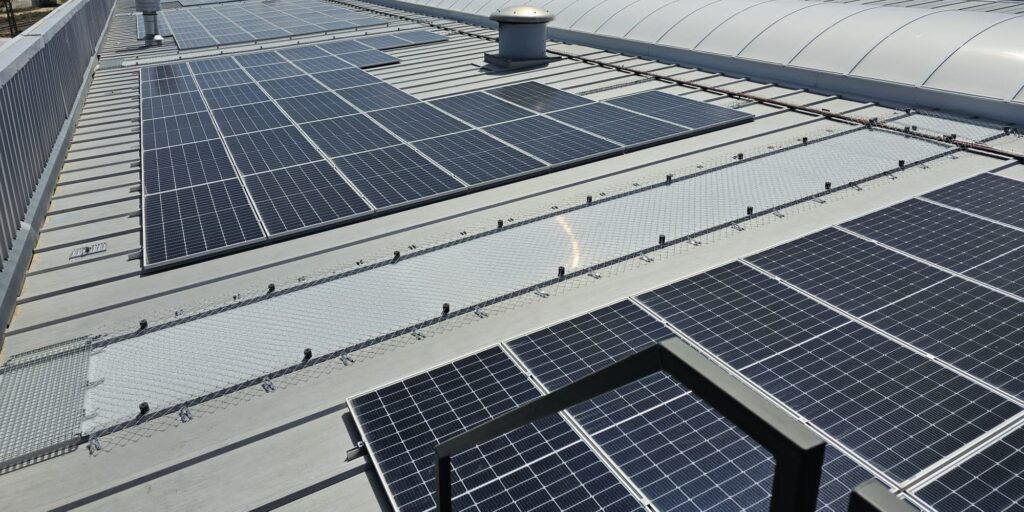
Work at height has become one of the activities with the highest rate of workplace accidents. Falls to a lower level remain one of the main causes of serious injury and workplace fatalities, mainly in the construction, industrial maintenance, and work-at-height sectors.
Although the work at height regulations have brought great progress in OHS legislation, common mistakes are still being made in fall prevention. Implementing appropriate procedures, using certified equipment, and carrying out prior assessments before any work are essential to creating safer, more efficient work environments.
Essential Safety Measures for Work at Height
Before carrying out work at height, the company must take several aspects into account:
- Access must be limited to qualified workers authorized by the company, with the appropriate training and knowledge of the risks and preventive measures that affect them, and the corresponding information.
- Have the necessary technical, material, and human resources. Collective protection must prevail whenever possible; otherwise, personal protective equipment will be used, choosing the equipment best suited to the work to be done.
- There must be an action plan in case of emergency, rescue, or salvage.
- In addition, a designated safety watch (preventive resource) must be present to supervise compliance with the preventive activities.
Collective Protection
Collective protection is a set of measures, devices, and systems designed to protect groups of workers from common risks in the workplace. This approach seeks to minimize the hazards for the entire group exposed to the same area or activity.
These are non-individual solutions that do not require the user to take any specific action, such as safety guardrails, safety nets, etc.
In occupational health and safety, collective protection is prioritized because it eliminates or reduces the risk at its source, and this is how it is specified in the OHS Act.
In addition, collective protection:
- Protects several people at the same time.
- Makes passage and maintenance tasks easier.
- Provides passive, constant safety.
- Reduces the need for specific training for each access.
Personal Protective Equipment (PPE)
Personal protective equipment consists of specific devices, accessories, or clothing intended to protect the worker from possible risks that could endanger their safety or health.
PPE is the last resort in the hierarchy of prevention; it is used when there are occupational risks that cannot be eliminated by other technical measures. Personal protection protects only the person who uses it correctly.
Risk Assessment Before Working at Height
In the risk assessment for a vertical workstation, some aspects must be taken into account that determine the choice of one piece of work equipment or another:
- Type of work to be performed
- Execution phases, including, where applicable, assembly and disassembly of the work equipment.
- Tasks to be performed in each of the phases.
- Assessment of task difficulty, taking into account the movements and gestures needed to perform them.
- Materials, tools, and other means that will be needed to carry out the activity.
- Duration of the activity.
- Height and location of the workstation.
- Estimate of the number of people needed to carry out the activity.
Regulations Applicable to Work at Height
In Spain, work at height is regulated by various standards, including:
- Occupational Risk Prevention Law 31/1995
- Royal Decree 2177/2004, establishing the minimum safety and health provisions for the use of work equipment by workers, with regard to temporary work at height.
- UNE and EN standards, for example:
- EN795
- EN14122
- EN353
Common Mistakes in Fall Prevention
Many accidents in work at height are caused by avoidable errors related to a lack of planning, overconfidence, or incorrect use of equipment.
Among the most common mistakes are:
- Not having the mandatory specific training. Many companies do not give this requirement the importance it deserves, exposing themselves to penalties and, above all, to serious accidents.
- Incorrect use or lack of Personal Protective Equipment (PPE). The fall arrest harness, lifelines, anchors, and helmets are not optional. Even so, many workers use them incorrectly, do not adjust them properly, or do not use them because they are uncomfortable.
- Failing to identify safe anchor points, attaching the harness to uncertified or unsafe structures.
- Underestimating the risk assessment. It is important to inspect the environment, assess risks, and apply the appropriate preventive measures before going up.
- Performing improvised maneuvers. For example, implementing a measure that has not been assessed beforehand, altering procedures, or delegating the work to unauthorized or unqualified personnel.
Frequently Asked Questions
Before carrying out work at height, the company must take several aspects into account:
– Access must be limited to qualified workers authorized by the company, with the appropriate training and knowledge of the risks and preventive measures that affect them, and the corresponding information.
– Have the necessary technical, material, and human resources. Collective protection must prevail whenever possible; otherwise, personal protective equipment will be used, choosing the equipment best suited to the work to be done.
– There must be an action plan in case of emergency, rescue, or salvage.
– In addition, a designated safety watch (preventive resource) must be present to supervise compliance with the preventive activities.
Collective protection must prevail whenever possible; otherwise, personal protective equipment will be used, choosing the equipment best suited to the work to be done.