


Manufacturing Safety Guardrails According to EN14122-3
Safety in work at height remains one of the main challenges in construction, industry, and facility maintenance. In this context, the safety guardrail has established itself as one of the most effective solutions among collective protection systems, eliminating or reducing the risk of falling without depending on the individual worker’s behavior.
However, not all guardrails offer the same level of safety and, most importantly, not all of them meet the required regulatory requirements. In Spain, the design and manufacture of these systems is mainly regulated by the EN14122-3 standard, Safety of machinery. Permanent means of access to machinery and industrial installations. Part 3: Stairs, stepladders and guard-rails.
This standard sets out the specific requirements for permanent guardrails providing access to machinery, in combination with Law 31/1995 on the Prevention of Occupational Risks, which establishes the obligation to give priority to collective protection measures over individual ones.
It is important to remember in which situations a safety guardrail must be installed:
- It must be installed near hazardous areas where there is a risk of collapse
- If the height of the possible fall is greater than 500mm
- If the gap between a platform and the wall is greater than 200mm, or if it exceeds 300mm, it must include a toe board.
- The distance between the axes of the posts should preferably be limited to 1500mm. However, if this is exceeded, special attention must be paid to the strength of the anchorage to the posts and of the fixing devices. This is the case with our Ananke Plate guardrail, tested at 1600mm.
- If access through the guardrail is required, a self-closing gate must be used.
From the manufacturer’s perspective, meeting these requirements means developing a comprehensive technical process that runs from the design phase through to product certification and installation.
In this article we detail how this process unfolds, which aspects are critical at each stage, and which mistakes must be avoided to ensure a safe, durable system that complies with regulations.
Stages of the Safety Guardrail Manufacturing Process
Design as the Basis for Regulatory Compliance
The development of a safety guardrail always begins in the technical design phase. This is where all the parameters that will determine whether the system can meet EN14122-3 are defined.
Geometry and Sizing
One of the fundamental aspects is the geometry of the system.
- The overall height, which must be at least 1100mm, and the layout of the handrail: there must be a maximum of 500mm of free gap below the top rail.
- The intermediate rail and the toe board, where the latter must in turn measure at least 100mm and may be separated from the floor by no more than 10mm
- As well as the spacing between posts, must comply with specific criteria set out in the regulations.

These parameters are not arbitrary: they respond to the need to prevent falls, stop people or materials from passing through, and ensure adequate strength against horizontal loads.
Installation Type
The design must take into account the planned type of installation. Depending on the substrate and the environment, the manufacturer develops different technical solutions:
- Counterweighted guardrails (Ananke Weight): for installations without roof penetration
- Floor-mounted guardrails (Ananke Ground): using chemical or mechanical anchors
- Guardrails for sheet metal (Ananke Plate): with specific fasteners adapted to metal profiles, mainly rivets with a watertight seal or self-drilling screws.
- Wall-anchored guardrails (Ananke Wall): to protect parapets, edges, or vertical openings
Each configuration has its own specific constraints that must be resolved at the design stage to ensure correct operation. Importantly, each of the different guardrail types must undergo separate standardization tests.
Special Adaptations
On sloped roofs or those with particular construction features, it is common to develop specific versions of the system, such as sloped guardrails that maintain the functional verticality of the assembly while adapting to the slope of the surface.
A poor design at this stage can cause serious problems later on: installation difficulties, regulatory noncompliance, or structural failures. This stage is therefore critical and requires in-depth knowledge of both the regulations and the real-world behavior of the systems.
Technical Development and System Modeling
Once the design criteria have been defined, the next step is to translate these specifications into a technical environment through 3D modeling and the preparation of manufacturing drawings.

The use of tools such as Catia, SolidWorks, and AutoCAD (computer-aided design) allows the manufacturer to validate the system before physically producing it. At this stage, the following are checked:
- All parts fit together correctly
- There are no geometric interferences
- Assembly will be feasible in real job-site conditions
- Manufacturing tolerances are appropriate
Modeling also facilitates the standardization of components, a key aspect for optimizing production and ensuring the repeatability of the product. It also makes it possible to simulate certain conditions of use, anticipating potential critical points that will need to be reinforced or redesigned.
This preliminary work significantly reduces manufacturing errors and helps improve both the quality of the final product and its ease of installation.

Material Selection: Technical Criteria
The choice of materials is another fundamental pillar in the manufacture of a safety guardrail. It is not simply a matter of meeting mechanical requirements, but of ensuring the durability of the system under real conditions of use.
Aluminum as the Main Material
Aluminum has become one of the most widely used materials in these systems because of:
- Excellent strength-to-weight ratio
- High resistance to atmospheric corrosion
- Ease of machining and forming
- Suitable performance in outdoor installations
Complementary Components
Alongside aluminum, it is common to use:
- Engineering plastic components: they make assembly easier, reduce the weight of the system, and prevent direct contact between metals, preventing galvanic corrosion. Always used in non-load-bearing elements.
Common Mistakes in Material Selection
One of the most common mistakes in the market is the use of unsuitable or insufficient-quality materials, which causes premature deterioration of the system and compromises its safety in the medium term. Selection must be carried out using rigorous technical criteria, considering the installation environment and the expected exposure conditions.
Industrial Manufacturing Process
Once the design and materials have been defined, the manufacturing process begins, which includes several operations:
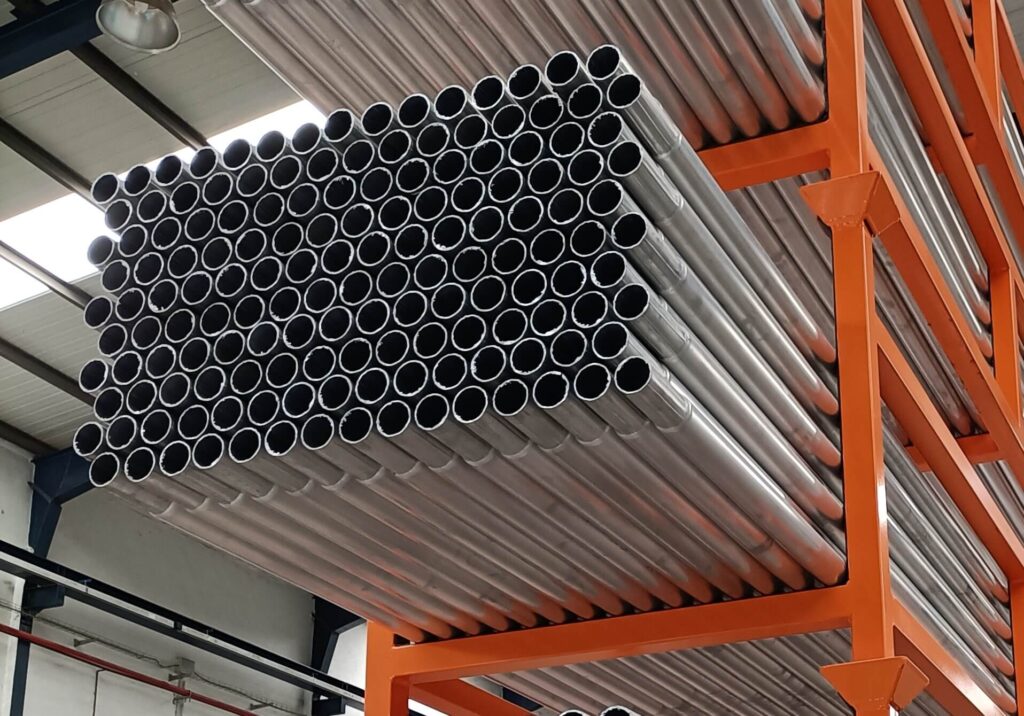
- Cutting and machining of aluminum profiles
- Punching of structural elements
- Assembly of components
- Preparation of installation kits
Precision and Repeatability
At this stage, precision and repeatability are critical factors. Each part must be manufactured according to the specifications defined in the design, respecting the established tolerances and ensuring the correct functionality of the assembly.
The organization of the production process directly influences efficiency and the manufacturer’s ability to offer competitive lead times. Standardizing components and optimizing processes make it possible to reduce costs and produce a more competitive guardrail without compromising quality.
Internal Testing and System Verification
Before submitting the product to official tests, the manufacturer must carry out internal tests intended to verify the behavior of the system.
These tests make it possible to check:
- Structural strength of the components
- Stability of the assembly under horizontal loads
- Correct performance of the joints and anchors
- Behavior under dynamic loading
Although they do not replace certified tests, these internal verifications are essential for detecting possible deficiencies and correcting them before moving forward in the process.
The goal is to minimize the risk of failure in the mandatory tests with external bodies and to ensure that the system meets the expectations defined in the design.
Quality Control and Product Consistency
Quality control is a cross-cutting stage that accompanies the entire manufacturing process, but it takes on particular importance in the final phase before going to market.
Aspects Verified
At this point, the following are reviewed:
- Dimensions and tolerances of the components
- Surface finishes and protective treatments
- Integrity of the structural components
- Correct assembly of the system
- Functionality of the fastening elements
An effective quality control system not only prevents defective products from leaving the factory, but also helps strengthen customer confidence and the manufacturer’s technical reputation.
Testing and Certification According to EN14122-3
One of the most important steps in manufacturing a safety guardrail is carrying out tests in accordance with the EN14122-3 standard.

Purpose of the Tests
These tests verify that the system:
- Withstands the loads for which it was designed
- Meets the safety requirements set by the standard
- Shows adequate structural behavior under horizontal loads
- Maintains its integrity under the intended conditions of use


Certification by Independent Bodies
Carrying out tests at independent laboratories or bodies (such as DEKRA, APPLUS+, etc.) provides an additional level of assurance and technical credibility. Certification:
- Objectively demonstrates regulatory compliance
- Makes it easier for OHS technicians to specify the product
- Provides confidence to health and safety managers
- Allows technical traceability of the system

Installation as an Integral Part of the System
Although it is often considered a separate phase, installation is an essential part of the guardrail system. A correctly designed and manufactured product must also be feasible to install in real job-site conditions.
Critical Installation Factors
- Speed of assembly: reduces time spent exposed to risk
- Ergonomics of the process: minimizes effort and awkward postures
- Adaptability to different surfaces: flexibility in varying conditions
- Clear instructions: make correct assembly easier
From the manufacturer’s point of view, designing systems that simplify installation provides significant added value, reducing execution times and minimizing the possibility of errors during assembly.
Common Mistakes in Guardrail Manufacturing and Selection
Despite the existence of clear regulations, solutions that fail to meet the necessary requirements persist on the market. Among the most common mistakes are:
- Lack of tests certified by independent bodies for all systems
- Use of materials of insufficient quality or unsuitable for the environment
- Designs that make installation difficult or create additional risks
- Lack of systematic quality control in production
- Incorrect sizing of structural components
- Lack of complete technical documentation
These problems not only affect the durability of the system, but can directly compromise the safety of users. It is therefore essential to select manufacturers that offer real guarantees of regulatory compliance and proven quality.
The Added Value of a Specialized Manufacturer
Beyond strict compliance with the regulations, a specialized manufacturer adds value in areas such as:
- Installation-oriented design: systems designed to make on-site assembly easier
- Modular systems: adaptability to different configurations
- Optimized job-site time: shorter installation times
- Technical support: advice during the project and installation phases
- Complete documentation: manuals, certificates, and technical data sheets
This approach improves productivity on site and reduces installation-related costs, without giving up the safety standards required by the regulations.
Conclusion
Manufacturing a safety guardrail in accordance with EN14122-3 is a complex technical process that requires the integration of specialized knowledge, rigorous quality control, and validation through certified testing.
From the initial design to the final installation, every stage of the process influences the behavior of the system and its ability to ensure workers’ safety. Complying with the regulations is essential, but not sufficient unless it is accompanied by proper technical execution at every stage.