


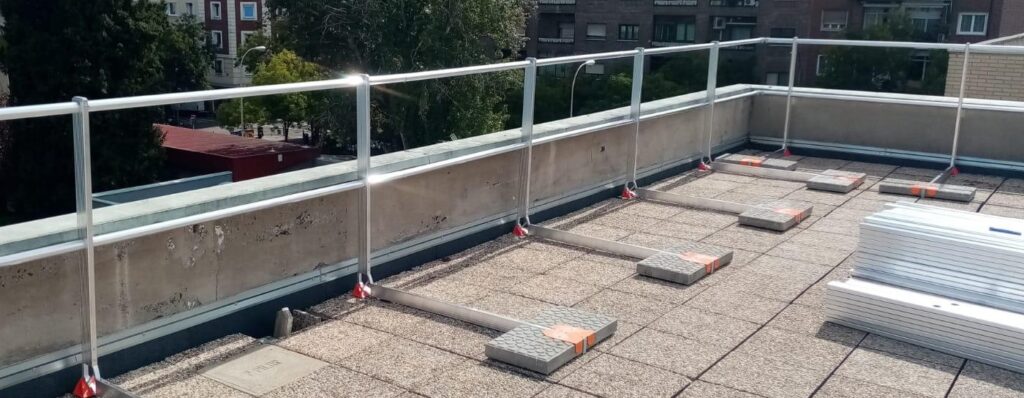
In the world of work at height safety, one increasingly used system is perimeter protection guardrails, also known as edge protection, which, thanks to their robustness and their various installation methods, make them a collective protection element.
This ensures compliance with the Occupational Risk Prevention Law 31/1995, Article 15, which establishes that measures giving priority to collective protection over personal protection must be adopted.
Therefore, one of the most important considerations when selecting and installing these safety systems is avoiding the mistakes that can arise from it.
In this post we will point out what these mistakes are and how we can avoid them.
What Mistakes Can We Make When Installing a Safety Guardrail?
First of all, before carrying out any type of installation, we must perform a risk assessment of the place where we are going to install these safety systems. This will help us avoid mistakes both in selecting the type of materials according to the environment and in sizing the system correctly.
Inadequate Material Selection
Depending on the environment we are exposed to, it will be advisable to choose one type of material or another.
In the most common cases we will find guardrails made of aluminum. Thanks to this material, we lighten the weight of the elements that make them up without adding excess weight to the roofs or installation areas, but it is not always the most suitable material.
There are times when we will be exposed to salt-laden, corrosive, or chemical environments, or even conditioned by the temperatures to be withstood in those environments. Taking these aspects into account, we can select the right type of material for each circumstance and thereby avoid premature deterioration of these systems and the risks that come with it.
The most common materials used to manufacture perimeter protection guardrails are the following:
- Aluminum.
- Stainless steel.
- GFRP.
Incorrect Use of Anchors
Another of the most common mistakes is the inadequate choice of anchors.
These connecting elements are what provide stability and uniformity to the guardrail installation, so it is essential to follow the manufacturers’ instructions regarding the hardware and the number of connecting elements needed to assemble their components and ensure a correct installation.
A poor choice, an incorrect tightening torque, or simply not following the manufacturers’ instructions for the prescribed elements can result in an unstable, short-lived system that loses the robustness that characterizes these safety guardrails.
Not Choosing the Most Suitable Type of Guardrail
As we noted above, these safety systems come in several models that adapt to the environment where they will be installed. Among them we can find:
- Freestanding guardrails: When we cannot make fixings to the installation base.
- Sheet-mounted guardrails: For trapezoidal metal sheet or sandwich panel floors.
- Wall-mounted guardrails: For installations where the guardrails will be fixed to walls or parapets.
- Floor-mounted guardrail: For all other circumstances, as long as they are not sheet metal floors, as we have seen above.
Choosing the right model based on the sizing we have done will help us avoid fixing errors. One of the most common problems is selecting an unsuitable model and then realizing during installation that we cannot drill into the roof, or that we must avoid doing so to prevent leaks later.
For this reason, and to know which model will work best with the environment where we are going to work, we always carry out a study before starting the installation.
Not Considering Subsequent Maintenance
Once the safety guardrails are installed, an inspection and maintenance protocol must be followed in order to extend their service life:
During these inspections we will check:
- Fixing elements: To make sure they have not come loose over time.
- Rust: a rusted guardrail must be repaired as soon as possible, because otherwise it will eventually break.
- Damage to its elements: since they are exposed to the outdoors, it is very common for them to become damaged.
Improper maintenance can lead to a greater risk of accidents, regulatory noncompliance, and increased legal liability.
How Can We Avoid Mistakes When Installing a Guardrail?
To avoid these mistakes, it is important to have an action plan that guarantees compliance with the standard and with safety standards.
Some measures to minimize this type of failure are:
- Carry out a thorough risk study
- Always opt for materials that meet quality and certification standards
- Train technical staff in the application of the UNE EN 14122 standard and in installation best practices
- Implement review and supervision protocols during and after installation
- Establish a schedule of periodic inspections to detect and correct any deterioration or anomaly in the structure
- Select and treat materials considering the environment in which they will be installed, whether in coastal areas, industrial areas, or areas with high exposure to corrosive agents
- Complement the installation with appropriate signage and inform users about the correct use of the system
Conclusion
As we have said, although installing a guardrail is a simple job, if it is not done well and with patience, it can lead us to commit irregularities that endanger workers.
We must pay attention to every detail, assess the risks well before installing, and choose the guardrail model and materials carefully.
To that end, at Ypsos Safety we advise following the instructions set out by the manufacturers and relying on qualified personnel for the sizing and installation of these safety systems.