


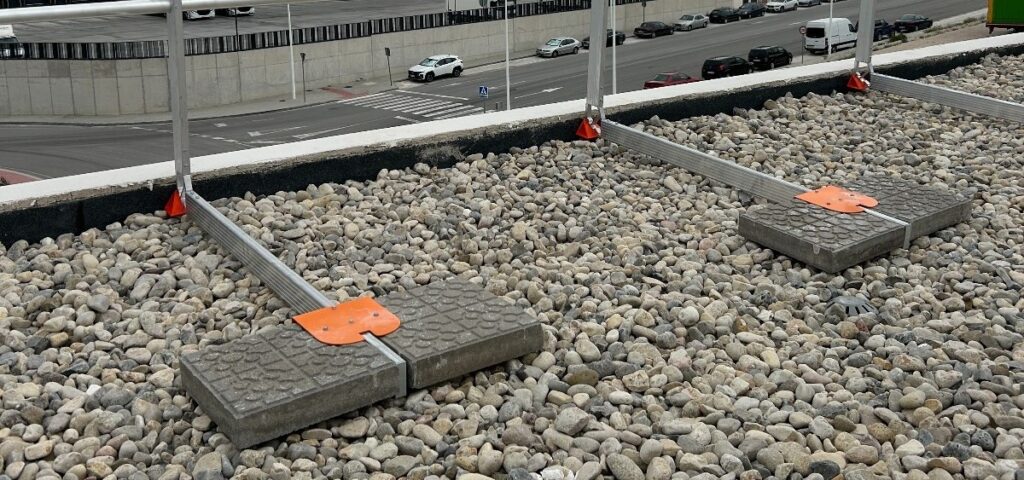
As we have mentioned in previous content, guardrails governed by the UNE EN ISO 14122 standard protect users against falls collectively, providing the necessary safety in different environments.
The usual places where we can find these safety elements are:
- Industrial roofs
- Roofs of commercial areas.
- Private or community-owned roofs.
- Access to machinery.
- Work platforms.
- Some types of stairs and crossovers.
This standard sets out the design, manufacturing, and strength requirements for safety guardrails. Within them, we can find two distinct models depending on installation needs:
Depending on the needs of each installation, the environment, and the specifications of each project, we can choose one of these two options. In this post we will look at the benefits and drawbacks of each.

What Are Freestanding Guardrails?
Freestanding guardrails have one main characteristic: they do not need to be anchored to any surface. Instead, they are fitted with counterweights that perform the same function as common fixing anchors.
It is an essential system in areas where fixing to the surface is not permitted, such as waterproofed roofs, roofs with some type of insulation, etc.
But these systems have a number of advantages as well as disadvantages compared to the other type, so let’s take a look.
Advantages of Freestanding Guardrails
- Installation without drilling: As we mentioned, this is the main advantage of this type of guardrail. In installations where, due to installation requirements or the environment itself, the use of anchoring elements is not allowed, we will turn to this type.
- Easy assembly: Since it does not require fixings to structural elements, the assembly process is faster, and it also saves us from having to carry a larger number of tools.
- Possibility of reuse and relocation: Because they are freestanding, if necessary, such as needing to use it in another part of that roof or if the layout of the space to be protected changes, we could keep the same system or simply add the new elements needed depending on the situation.
Disadvantages of Freestanding Guardrails
- Greater weight: Since it is a counterweighted safety system, these guardrails place loads on roofs that are sometimes not good for them, and they also make transport and handling more difficult.
- Aesthetics: An area protected with a freestanding guardrail can have an unfavorable visual impact compared to the fixed type, which has fewer components.
- Limitation in very windy environments: One of the main drawbacks of this type is the risk in strong winds because of the possibility of tipping over, although the standard gives us the necessary guidelines on how to act in these situations.

What Are Fixed Guardrails?
This type of guardrail is installed permanently by making the necessary mechanical fixings depending on the installation location, whether it be floor, wall, sheet metal, etc.
Advantages of Fixed Guardrails
- Greater stability: Structurally, since they are fixed directly to a surface, they can offer a more durable option in the long term than freestanding guardrails.
- Lower visual impact: Since there are no counterweights, we reduce the number of components and with it the visual impact of the parts, while also reducing the weight on the installation site.
- Suitable for all types of environments: Unlike the freestanding type, in very windy areas they will be a safer option.
Disadvantages of Fixed Guardrails
- Longer installation times: Since holes must be drilled in the surfaces where they will be fixed, assembly takes longer.
- Possible leaks through the waterproofing: The anchors can pierce insulation layers, so special attention must be paid to the waterproofing after installation to prevent this.
- Less potential for reuse: Since they are permanent elements, we would not be able to move the structure if necessary.
Conclusion
Both freestanding and fixed guardrails have their role in occupational risk prevention, and both meet the technical, design, and manufacturing requirements specified in the UNE EN ISO 14122 standard.
That is why it is essential to decide carefully which system fits our particular project and not overlook any detail in order to avoid problems later. Before choosing one system or another, we will carefully assess the situation at each installation site.
Having a properly qualified team can make the job easier for us. That is why, as always, we recommend turning to work-at-height safety professionals, who will carry out the corresponding assessment and advise us on the type of system needed.